


Identify Eczema Triggers in Skincare: A Step-by-Step Guide
Table of Contents
- Why Eczema Triggers in Skincare Matter
- Common Skincare Ingredients That Trigger Eczema
- How to Patch Test Skincare for Eczema
- How Long to Test a New Skincare Product
- Using an Eczema Flare-Up Diary to Track Triggers
- Building a Safe Skincare Routine for Eczema-Prone Skin
- When to See a Dermatologist About Eczema Triggers
- Frequently Asked Questions
Last Updated: October 15, 2026
Why Eczema Triggers in Skincare Matter
Understanding eczema triggers skincare products is one of the most practical steps you can take to reduce flare-ups and protect your skin barrier.
Eczema triggers vary widely, so a systematic approach to identifying yours matters. Many businesses help families navigate sensitive skin by understanding which ingredients cause the most problems.
With eczema or atopic dermatitis, your skin barrier lets irritants in more easily and loses moisture faster.
Common Skincare Ingredients That Trigger Eczema
Not every ingredient causes problems for everyone, but some known irritants repeatedly show up in products that trigger flare-ups for eczema-prone skin.
Fragrances and Fragrance Masking Agents
Fragrance is one of the most common culprits. It appears as "fragrance" or "parfum" on labels and hides in "unscented" products that use masking agents.
Look for "fragrance-free" rather than "unscented." Fragrance-free means no fragrance was added at all; unscented often means fragrance is still there, just masked.
Wellaroma's African Black Soap-Unscented ($5.99) is specifically formulated without fragrance or dyes, making it a solid choice for sensitive to eczema-prone skin.

Sulfates, Dyes, and Harsh Surfactants
Sulfates are lather-creating cleansers that strip natural oils, such as sodium lauryl sulfate (SLS) and sodium laureth sulfate (SLES).
When sulfates remove too much oil, your skin barrier weakens. Irritants penetrate more easily. Itching and redness follow (pubmed.ncbi.nlm.nih.gov).
Dyes add color but serve no skincare purpose, they're pure irritants for sensitive skin, and many flare-ups spike after a brightly colored body wash or lotion.
Harsh surfactants work like sulfates, damaging the skin's protective layer. If a product leaves skin tight or dry after use, it likely contains them.
Check labels for:
- Sodium lauryl sulfate (SLS)
- Sodium laureth sulfate (SLES)
- Ammonium lauryl sulfate
Alcohol and Preservatives
Alcohol dries out skin quickly, especially problematic for eczema-prone skin that already struggles to retain moisture, leaving it more vulnerable to irritants.
Certain preservatives can also trigger reactions. Methylisothiazolinone (MIT) and methylchloroisothiazolinone (CMIT) are linked to contact dermatitis in sensitive individuals (pubmed.ncbi.nlm.nih.gov).
Not all preservatives are bad, your skin needs protection from bacteria and mold.
How to Patch Test Skincare for Eczema
Patch testing is the most reliable way to find out whether a product will trigger your eczema. It is not a diagnosis and does not replace professional allergy patch testing, but it is a low-risk way to screen products before whole-body use.
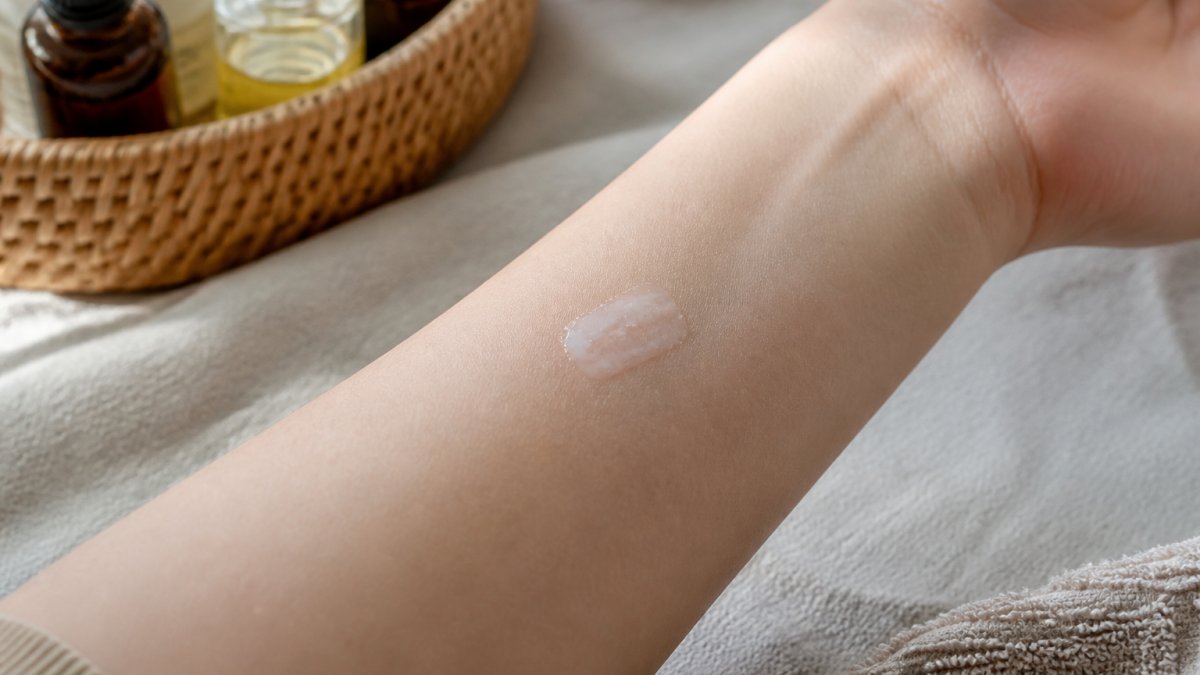
Two different reactions behave differently:
- Irritant contact dermatitis, damage to the skin barrier from a harsh ingredient (a strong surfactant, a high-percentage acid, denatured alcohol). It usually shows up within minutes to a few hours, stays confined to where the product touched, and feels like stinging, burning, tightness, or dryness.
- Allergic contact dermatitis, an immune reaction to a specific allergen (a fragrance component, a preservative like methylisothiazolinone, certain plant extracts). It often appears 24-72 hours after contact, can spread beyond the application site, and tends to itch intensely or blister.
That timing difference is why a single 24-hour check is not enough. A product can look completely fine on day one and still cause a delayed reaction on day three.
Preparing for Your Patch Test
Choose a small, inconspicuous area, the inner forearm or side of the neck works well. Avoid spots with active eczema, broken skin, or a recent flare.
Wash the area with lukewarm water and a cleanser you know is safe, then pat dry. Apply no moisturizer, sunscreen, or other product there during the test.
Use only a pea-sized amount.
Performing the Test
Apply the product to the test spot and let it sit. Do not cover it with a bandage or tape unless the product's instructions say to.
Leave it on for 24 hours without washing it off or applying anything else there.
After 24 hours, wash the spot with lukewarm water and check it under good light, then again at 48 and 72 hours.
Reading Your Results
No reaction at 24, 48, and 72 hours: The skin looks unchanged.
Immediate stinging, burning, or redness within minutes: This is an irritant reaction.
Redness, itching, or bumps appearing 24-72 hours later, especially spreading past the test spot: This points toward an allergic contact reaction.
Mild redness that fades within a few hours of washing off: Borderline.
One Variable at a Time
A patch test only tells you something useful if you change one thing at a time. Test three new products on the same day and react, and you have learned nothing about which one caused it.
A practical sequence:
- Patch test product A on day 1. Check at 24, 48, and 72 hours.
- If clear, start a use test with product A on a larger area (for example, one arm) for 3-5 days.
- Only after product A is confirmed safe do you patch test product B.
This is slow. It is also the only way to end up with a routine where you actually know what is safe for your skin.
What Patch Testing Cannot Tell You
A clear patch test does not guarantee a product is safe forever. Your barrier changes with the seasons, stress, sleep, and how many products you layer, something that passed in a calm week can still sting during a flare.
A patch test also cannot identify an allergen you have not yet been exposed to. A fragrance-containing product may test clear today, yet repeated exposure can still create a sensitivity months later, one reason many dermatologists recommend keeping fragrance out of a daily routine for eczema-prone skin regardless of test results.
How Long to Test a New Skincare Product
When testing a new product, understanding eczema triggers skincare should take at least 48 hours before whole-body use.
Even after a successful patch test, introduce new products one at a time, waiting 3-5 days between additions.
Many people rush this and use multiple new products at once, then can't identify the culprit when a flare-up occurs.
African Black Soap-Unscented (Sensitive Eczema Prone Skin) →
Using an Eczema Flare-Up Diary to Track Triggers
A flare-up diary is the single most useful tool for identifying your personal eczema triggers, because it is the only way to connect a specific product to a reaction across days or weeks. Memory is unreliable, you will not remember which body wash you used four days before a flare started.
The goal is not to log forever, but to collect enough structured data over 3-4 weeks to see patterns, then simplify.
A Reusable Log Format
You do not need an app. A notebook with one row per day works. Use these columns:
| Date | Products used (cleanser, moisturizer, body wash, detergent, deodorant, sunscreen) | New product introduced? (Y/N + name) | Skin status (0-3) | Itch level (0-3) | Sleep (hrs) | Stress (0-3) | Weather / humidity | Notes |
|---|
A simple severity scale keeps entries comparable day to day:
- 0, clear, no symptoms
- 1, mild dryness or occasional itch, no visible redness
- 2, visible redness, consistent itch, rough or flaky patches
Log once a day, ideally at night before bed, to capture the day's full exposure. If a flare starts mid-day, note the time, timing often separates an irritant reaction (fast) from an allergic one (delayed).
What to Record (and Why)
Products, by name and ingredient. "Lotion" is not useful; "Brand X Daily Lotion, started Oct 3" is.
Environmental factors. Temperature, humidity, and season matter because dry air and heat weaken the barrier.
Sleep and stress. Both are well-known flare amplifiers. A 0-3 stress rating and hours slept are enough.
Diet, only if you suspect it. Food triggers are real for some but far less common than skincare and environmental triggers.
A Simple Decision Framework
After 3-4 weeks, read the diary in this order:
-
Look for a new product in the 1-3 days before each flare. If the same product precedes multiple flares, that is your strongest signal, stop using it and see whether flares stop.
-
Look for flares that do not line up with any new product. These are likely environmental, stress-related, or seasonal. If flares cluster in winter, your routine may need a heavier moisturizer rather than a product removal.
-
Look for flares that line up with a specific ingredient across different products. If two lotions both cause reactions and share a preservative or fragrance component, that ingredient is your likely allergen, the pattern home diaries catch best.
-
Look for flares with no pattern at all. If nothing lines up after a month of careful logging, the trigger may be something untracked (laundry detergent on sheets, a pet, dust mites), or your eczema may need medical management rather than trigger-hunting.
From Diary to Action
A diary is only useful if it changes what you do. Once you have a likely trigger, remove it and hold everything else constant for 2-3 weeks.
Bring the diary to a dermatologist if your eczema is moderate to severe, flares are frequent, or you cannot find a pattern alone. A clinician can order professional patch testing against standardized allergen panels, far more sensitive than anything you can do at home.
Building a Safe Skincare Routine for Eczema-Prone Skin
Once you've identified your triggers, building a safe routine becomes straightforward. The goal is simplicity and consistency.
Starting with Minimal Products
Less is more with eczema-prone skin. Many people think more products mean better care. The opposite is true.
Start with three essentials:
- A gentle cleanser
- A moisturizer
- Sunscreen (if you go outside)
That's it. Don't add anything else until you've used these three for at least two weeks without flare-ups.
Each product should be fragrance-free, dye-free, and free of harsh surfactants. Test each individually before using them together.
Wellaroma's Humble Deodorant - Simply Unscented ($10.99) is formulated for sensitive skin with no aluminum, alcohol, dyes, or parabens.

Reading Labels and Recognizing Red Flags
Learn to read ingredient lists. Ingredients are listed by weight, and the first five matter most.
Red flags to watch for:
- Fragrance or parfum listed anywhere
- Dyes or colorants
- Sulfates (SLS, SLES)
Green flags suggest safer products:
- Fragrance-free (not unscented)
- No dyes
- Plant-based or gentle preservatives
Compare products side by side. The one with fewer red flags is usually the safer choice.
When to See a Dermatologist About Eczema Triggers
If you've identified your triggers and avoided them but still experience frequent flare-ups, see a dermatologist.
A dermatologist can perform formal patch testing, applying small amounts of common allergens under controlled conditions.
They can also rule out conditions that mimic eczema, contact dermatitis, seborrheic dermatitis, and others require different treatments.
Prescription treatments like topical corticosteroids or calcineurin inhibitors control severe inflammation, and work best combined with trigger avoidance.
Identifying your personal eczema triggers takes time, but it's the foundation of managing your skin. At Wellaroma, we believe eczema-prone skin deserves products formulated with care, like our African Black Soap-Unscented that skips fragrance and dyes. Start your routine today and give your skin the gentle care it needs.
Frequently Asked Questions
How can I tell if a skincare product is triggering my eczema?
Watch for increased itching, redness, rash, or flare severity within 24-72 hours of using a new product. Use a patch test on a small area first to isolate the reaction before applying it to larger skin areas. Keep detailed records of which products cause symptoms. If redness or itching persists, stop using the product immediately and switch to a fragrance-free, hypoallergenic option like our African Black Soap for sensitive skin, which contains no parabens, sulfates, or synthetic fragrances.
How long should I wait before trying another skincare product if I have eczema?
Wait at least 2-4 weeks between introducing new products to allow your skin barrier to stabilize and any potential reaction to appear. This timeline lets you clearly identify which product caused a flare-up. If you introduce multiple products at once, you won't know which one triggered the irritation. During the waiting period, maintain your current routine and keep detailed notes on your skin's condition to track patterns.
Which skincare ingredients commonly irritate eczema-prone skin?
Common irritants include fragrances (even fragrance-free products may contain fragrance masking agents), sulfates like SLS, alcohol denat, synthetic dyes, parabens, and certain essential oils in high concentrations. Avoid products listing these early in the ingredient list. Look for products with simple formulations. Our Baby Body Wash uses a minimal amount of essential oil and organic saponified oils.
How do I keep a skincare and eczema flare-up diary?
Record the date, time, products used, environmental conditions (weather, heat, humidity), stress level, and any symptoms (itching severity, redness, rash location, oozing, or bleeding). Rate flare severity on a scale of 1-10. After 4-6 weeks, review your entries to identify patterns. You'll likely notice which products, ingredients, weather conditions, or stress levels consistently precede flare-ups, making it easier to avoid triggers.

Leave a comment