


Why Natural Ingredients Matter for Sensitive Skin
Table of Contents
- Why Natural Ingredients Matter for Sensitive Skin
- How Natural Skincare Ingredients for Sensitive Skin Support the Skin Barrier
- Botanical Ingredients That Soothe and Calm Reactive Skin
- Natural Does Not Automatically Mean Safe: Allergic Reactions to Watch For
- How to Choose Skincare for Sensitive Skin Without Guessing
- How to Do a Sensitive Skin Patch Test Before Full Use
- Conclusion: Building a Gentle Routine That Respects Your Skin
- Frequently Asked Questions
Last Updated: October 12, 2026
Why Natural Ingredients Matter for Sensitive Skin
Natural ingredients matter for sensitive skin because they typically skip the synthetic preservatives, artificial fragrances, and harsh chemicals that trigger irritation in reactive skin.
This guide from Wellaroma covers what actually separates a gentle formula from an irritating one, which botanical ingredients earn their place, and how to test any new product safely before committing.
The case for nature-based skincare rests on a simple idea: fewer additives means fewer chances for your skin to react badly.
How Natural Skincare Ingredients for Sensitive Skin Support the Skin Barrier
Natural skincare ingredients for sensitive skin support the skin barrier by reducing irritant exposure while supplying hydration and soothing compounds. The skin barrier is the outermost layer of skin cells and lipids that keeps moisture in and irritants out.
Synthetic preservatives and artificial fragrances are common culprits behind barrier disruption. Switching to formulas built on plant-based ingredients, organic oils, and gentle botanicals lowers that daily irritant load.
Hydration, Redness, and Fewer Synthetic Irritants
Hydration is the fastest visible win. Dry skin cracks at the microscopic level, which lets irritants deeper in and makes everything sting. A well-formulated organic body wash or shower oil leaves skin comfort intact instead of stripping it.
Redness often follows the same pattern. Fewer harsh chemicals means a calmer skin response, and calming ingredients like aloe and oat help settle reactive skin further.
Botanical Ingredients That Soothe and Calm Reactive Skin
The most commonly cited soothing botanicals are colloidal oat, chamomile, aloe, calendula, and licorice root. Each has a plausible mechanism, but the effect depends heavily on concentration, processing, and what else is in the formula. A botanical listed near the bottom of an ingredient list is often present at a token amount.
- Colloidal oat: The finely milled oat fraction is the best-studied of the group. Oat contains avenanthramides and beta-glucans that are associated with reduced itching and redness, and colloidal oat is recognized in over-the-counter skin protectant drug products. It works best when it appears high on the list, not as a trace additive.
- Chamomile: Contains bisabolol and chamazulene, which are associated with calming reactive skin. The trade-off is that chamomile is in the daisy family, so people with ragweed or related allergies can react to it.
- Aloe: The inner-leaf gel is hydrating and cooling. Aloe latex, the yellow sap just under the leaf skin, contains anthraquinones that can irritate, so quality processing matters.
- Calendula: A gentle botanical traditionally used for delicate skin. Evidence is mostly traditional rather than clinical, so treat it as a comfort ingredient, not a treatment.
- Licorice root: Contains glabridin and licochalcone, which are associated with reducing the appearance of redness. It is a common addition to formulas aimed at reactive or redness-prone skin.
Concentration, Processing, and the Whole Formula
Two products can list the same botanical and behave completely differently. Three variables explain most of the gap:
- Concentration. Ingredient lists are ordered by weight, so position tells you roughly how much is present. A soothing extract after the preservative is likely there for the label, not the skin.
- Processing. Cold-pressed, glycerin-extracted, and standardized extracts can carry different levels of active compounds. Standardization is what lets a formulator deliver a consistent amount batch to batch.
- The rest of the formula. A soothing botanical in a base with high alcohol, strong surfactants, or added fragrance can be overwhelmed by the irritants around it. The complete formula, not the hero ingredient, determines tolerability.
What the Evidence Actually Supports
The strongest evidence for sensitive-skin benefit sits with barrier-supporting and humectant ingredients rather than exotic botanicals. Colloidal oat, glycerin, ceramides, panthenol, and petrolatum have the most consistent support for reducing dryness and irritation.
A practical rule: favor formulas where the soothing ingredient appears early in the list, the base is short and fragrance-free, and the brand can tell you the concentration or at least the extract ratio.
Natural Does Not Automatically Mean Safe: Allergic Reactions to Watch For
Natural does not automatically mean safe or non-irritating. This is the part most "go natural" guides skip, and it matters.
Essential oils are the biggest offender. Lavender, citrus, and tea tree oils are common sensitizers, especially undiluted or at high concentrations.
Watch for these signs after trying any new product:
- Redness or a rash that appears within hours to days
- Itching, burning, or stinging that does not settle
- New breakouts along the application area
- Swelling or hives, which warrant stopping immediately
If a reaction is severe or spreading, stop using the product and seek medical care. For mild irritation, discontinue use and let your skin settle before trying anything new.
How to Choose Skincare for Sensitive Skin Without Guessing
Choosing skincare for sensitive skin comes down to reading the label honestly, not trusting the front of the package. Terms like "natural," "organic," "clean," and "hypoallergenic" are largely marketing language in the United States, and understanding what they do and do not guarantee is the difference between a smart purchase and a hopeful one.
African Black Soap-Unscented (Sensitive Eczema Prone Skin) →
Start with these selection criteria:
- Short ingredient lists. Fewer ingredients means fewer chances for a reaction.
- No added fragrance or dyes. Fragrance is one of the most common causes of contact dermatitis.
- Barrier-supporting ingredients near the top. Look for glycerin, ceramides, colloidal oat, panthenol, or petrolatum high in the list.
- Formulated and labeled for sensitive or dry skin. A product built for reactive skin is less likely to surprise you.
- Full ingredient disclosure. A brand that lists every ingredient, including fragrance components, is one you can actually evaluate.
What "Natural," "Organic," and "Hypoallergenic" Really Mean
These terms are not interchangeable, and most are not tightly regulated for cosmetics:
- "Natural" has no legal definition for cosmetics. A product can be labeled natural and still contain synthetic preservatives or processing aids.
- "Organic" is only meaningful if the product carries a USDA organic seal. The USDA certifies agricultural ingredients, not the finished cosmetic, so a product can be "made with organic ingredients" without being fully organic.
- "Hypoallergenic" is not defined by regulation. It generally signals that the brand avoided common allergens, but it is not a guarantee for any individual.
- "Fragrance-free" is the more useful claim for reactive skin. "Unscented" can still contain masking fragrance to cover the smell of raw materials, so the two are not the same.
- "Dermatologist-tested" means a product was tested on people under dermatological supervision, not that it passed a specific standard or that it will suit your skin.
Reading an Ingredient List Like a Formulator
Ingredient lists follow a set order: ingredients at 1% or more are listed by weight from highest to lowest, and everything below 1% can appear in any order. That single rule tells you a lot.
- If a soothing botanical appears after the preservative, assume it is present at a low level.
- Fragrance and preservatives are usually the last items, which is why "fragrance" can hide dozens of individual compounds under one word.
- Watch for common sensitizers even in "natural" products: essential oils such as lavender, citrus, tea tree, and peppermint, plus preservatives like methylisothiazolinone.
| What to Look For | Why It Matters | Red Flag |
|---|---|---|
| Short ingredient list | Fewer potential irritants | Long lists with many botanicals |
| "Fragrance-free" | Avoids a top trigger | "Unscented" or "natural fragrance" |
| No dyes | Reduces irritation risk | Artificial colorants like FD&C dyes |
| Barrier ingredients high on the list | Supports the skin barrier | Soothing extract listed last |
| USDA organic seal (if organic matters to you) | Verifiable claim | "Organic" with no seal |
Our African Black Soap-Unscented is a reasonable example of the short-list approach: made with charcoal from roasted cocoa pods and plantain skins, blended with shea butter and coconut oil, and free of parabens, SLS, fragrance, and dyes.

How to Do a Sensitive Skin Patch Test Before Full Use
A sensitive skin patch test is a simple safety step: apply a small amount of product to a small area of skin, wait 24 to 48 hours, and check for a reaction before using it widely.
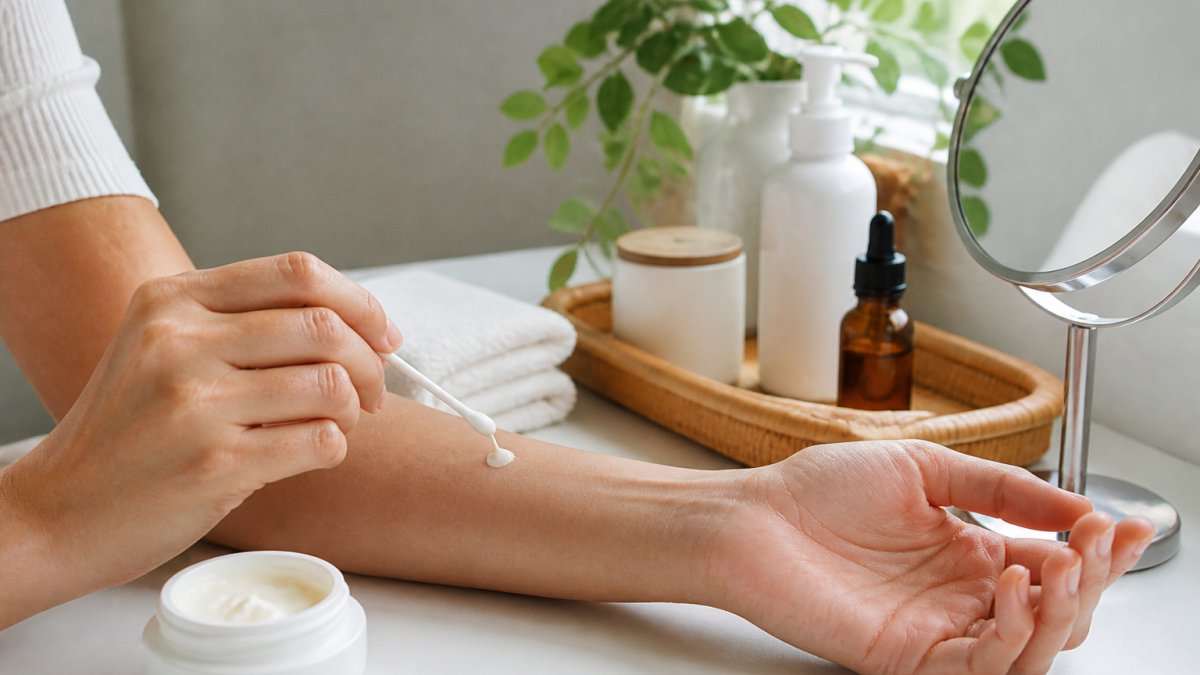
Here is how to do it properly:
- Pick a test spot. The inner forearm or behind the ear works well, since the skin there is thin and reactive.
- Cleanse and dry the area. Do not apply to broken or irritated skin.
- Apply a small amount. A pea-sized dot is plenty.
- Leave it uncovered. Do not wash the area for 24 hours.
- Check at 24 and 48 hours. Look for redness, itching, swelling, or breakouts.
- Introduce one product at a time. Wait a few days between new products so you can identify the culprit if something goes wrong.
If you see no reaction after 48 hours, you can begin using the product as directed. If you notice irritation, wash it off and discontinue use.
Conclusion: Building a Gentle Routine That Respects Your Skin
Sensitive skin does not need a complicated routine. It needs fewer irritants, consistent hydration, and products you have actually tested on your own skin. Get those three right and most of the drama settles down.
When you are ready to build that routine with formulas made for reactive skin, Wellaroma's plant-based masks and gentle cleansers are a natural place to start. Our Vanilla Oat Milk Nourishing Plant-Based Milk Mask and Strawberries and Cream Soothing Raw Juice Face Mask use soothing oat, vanilla, and strawberry extracts to calm stressed skin without a long list of additives.


For more on what to avoid, the FDA's guidance on cosmetics and ingredient safety is a useful reference when you are evaluating any new product. And for broader skin-care fundamentals, the National Institutes of Health skin health overview covers how the skin barrier works and why gentle care matters.
Start with one gentle product, patch test it, and let your skin tell you what it thinks. Then add to cart with confidence.
Frequently Asked Questions
Are natural ingredients better for sensitive skin?
They can be, but it depends on the ingredient and the formulation. Plant-based ingredients like chamomile, oat, and aloe are often used for their soothing and calming properties, and skipping artificial fragrances and synthetic preservatives may reduce irritation for some people. That said, natural ingredients can still trigger allergic reactions. A product with fewer additives and clear ingredient transparency is a better starting point than one marketed only as 'natural'.
Can natural ingredients irritate sensitive skin?
Yes. Botanical ingredients are not automatically gentle. Essential oils, plant extracts, and natural fragrances can cause redness, breakouts, or allergic reactions in reactive skin, especially when used at high concentrations. This is why a sensitive skin patch test matters before you apply anything to your face or your child's skin. Test on a small area, wait 24 to 48 hours, and stop if you notice itching, burning, or swelling.
How do I test a new skincare product on sensitive skin?
Apply a small amount to your inner forearm or behind your ear, then wait 24 to 48 hours. If there is no redness, itching, or swelling, try a small area on your face. Introduce one new product at a time so you can tell what caused a reaction. Keep the patch test area clean and avoid washing it during the wait period for the clearest result.
What should I look for when choosing skincare for sensitive skin?
Look for short ingredient lists, fewer additives, and transparent labeling. Fragrance-free or unscented options are often a safer choice than products with artificial fragrances. Ingredients like shea butter, coconut oil, oat, and aloe can support hydration and skin comfort. If a product claims to be hypoallergenic, check whether the brand explains what that means for their formulation rather than treating it as a guarantee.

Leave a comment