


Aromatherapy Blends for Stress Relief: 2026 How-To Guide
Table of Contents
- Essential Oil Dilution Ratios: The Safety Foundation
- How to Use a Diffuser for Stress Relief
- DIY Calming Essential Oil Recipes for Stress Relief
- Best Aromatherapy Blends for Stress Relief: Oils That Work
- How to Choose High-Quality Essential Oils for Stress Relief
- Personalized Blend Testing: Find Your Perfect Aromatherapy Blend
- Frequently Asked Questions
Last Updated: September 11, 2026
Essential Oil Dilution Ratios: The Safety Foundation
Aromatherapy blends for stress relief only work when diluted correctly. Essential oils are highly concentrated, and applying them undiluted can cause skin irritation or sensitization. The standard dilution for daily adult use is 2-3% essential oil in a carrier oil, roughly 12-18 drops per ounce.
The same blend that relaxes one person can burn another, so get the ratio right first.
Dilution Chart for Adults and Children
| Who | Dilution | Drops per 1 oz Carrier | Best For |
|---|---|---|---|
| Adults (daily) | 2-3% | 12-18 drops | Rollerballs, massage |
| Adults (acute) | 5% | 30 drops | Short-term, localized |
| Children 6-12 | 1% | 6 drops | Gentle daily support |
| Children 2-6 | 0.5% | 3 drops | Very gentle use |
| Infants under 2 | Avoid | None | Consult a pediatrician |
Carrier oils matter too. Jojoba absorbs quickly and suits most skin types, while sweet almond is heavier and better for dry skin.
Pet Safety and Contraindications
Diffusing essential oils around pets is riskier than most people realize. Cats lack the liver enzymes needed to metabolize many essential oil compounds, and diffused oils can trigger respiratory distress in cats and dogs. Tea tree, citrus, peppermint, and eucalyptus are the most concerning.
If you diffuse, keep the room ventilated and give pets a clear exit. Birds are especially vulnerable. When in doubt, skip the diffuser and use a personal rollerball away from your pets.
People with asthma, pregnant individuals, and anyone on medication should check with a healthcare provider before regular use.
How to Use a Diffuser for Stress Relief
The right way to use a diffuser for stress relief: add water to the fill line, add 3-5 drops of your chosen essential oil blend, and run it for 30-60 minutes in a well-ventilated room. Longer sessions do not increase benefits and can cause headaches or nausea.
Here is the step-by-step:
- Fill the reservoir to the marked line with cool water. Overfilling can splash the ultrasonic plate and shorten the unit's life.
- Add 3-5 drops total of your blend. Start low; you can always add more next time. For a small bedroom (under 150 square feet), 3 drops is plenty; for an open living area, 5 drops is the ceiling.
- Place the diffuser at least three feet from where you sit or sleep, never under a wall outlet or on porous wood.
- Run for 30-60 minutes, then air the room out. Set a timer rather than relying on the auto-shutoff, which only triggers when the water runs dry.
- Clean the reservoir weekly with warm water and white vinegar. Oil residue mutes the scent and can harbor bacteria.
A common mistake is running a diffuser all night in a closed bedroom, turning a calming ritual into an irritant. Set a timer instead.
Why Scent Works on Stress at All
When you inhale an essential oil, volatile molecules bind to olfactory receptors, which send signals along the olfactory nerve directly to the limbic system, the part of the brain tied to emotion, memory, and the stress response, including the amygdala and hippocampus.
This pathway bypasses the thalamus, the relay station that filters most other sensory input before it reaches the cortex. That is why a familiar scent can shift your mood before you consciously register it, and why the effect can feel faster than a pill. The National Center for Complementary and Integrative Health overview of aromatherapy explains how this pathway differs from other senses.
Because the limbic system is involved in memory, a scent you associate with a calm place or person will work better for you than one a stranger recommends.
Diffuser vs. Inhaler vs. Rollerball: Which Method Fits
Diffusion is the most popular method, but not always the best. Here is how the three main inhalation methods compare:
- Ultrasonic diffuser. Best for room-level coverage and a 30-60 minute wind-down. Not ideal for on-demand use, and not safe around pets who cannot leave the room.
- Personal inhaler (nasal stick). A small tube with a wick soaked in a few drops of oil. Best for acute moments like a stressful meeting or commute. Discreet, portable, and does not affect anyone else.
- Rollerball on pulse points. Best for a slow, all-day release. The carrier oil slows evaporation, so the scent lingers on wrists and temples rather than filling a space. Safest option in a home with pets.
If your stress is situational and short-lived, an inhaler or rollerball serves you better. If it is a background hum you want to soften for an hour, diffusion is the right tool.
DIY Calming Essential Oil Recipes for Stress Relief
DIY calming essential oil recipes are where aromatherapy gets personal. Start with a base ratio of 3 parts calming floral to 2 parts citrus to 1 part grounding wood or resin, then adjust to taste.
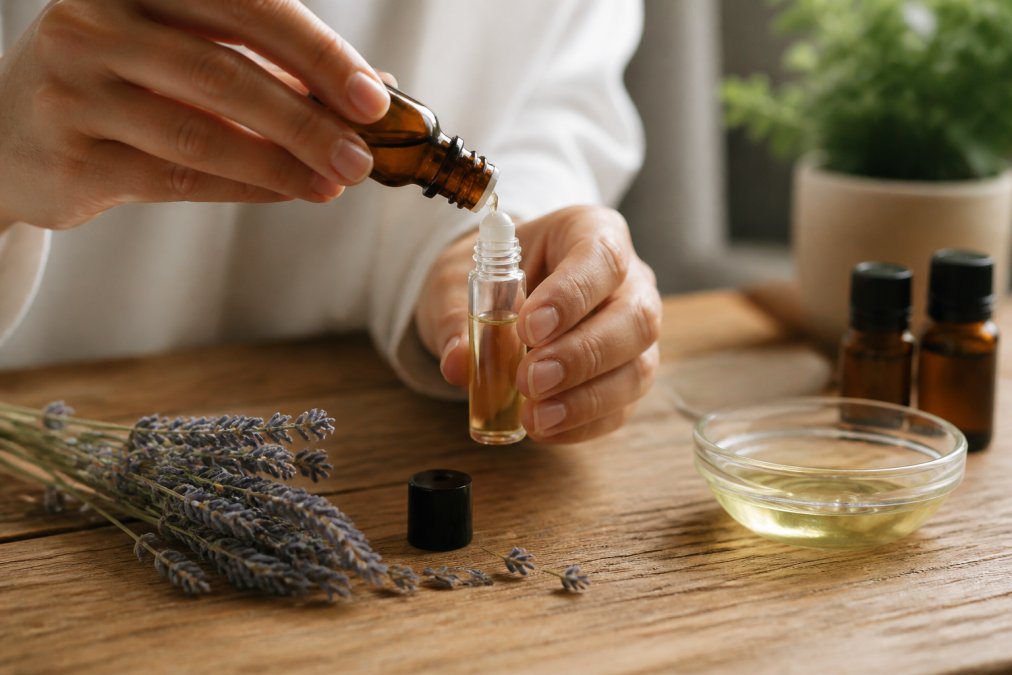
Calm Evening Rollerball (10 mL)
- 6 drops lavender
- 4 drops bergamot
- 2 drops frankincense
- Top with jojoba or fractionated coconut oil
Roll onto wrists and temples, breathe deeply, and give it a minute. Keeps about six months in a cool, dark spot.
Diffuser Blend for a Stressful Afternoon
- 3 drops bergamot
- 2 drops clary sage
- 1 drop ylang-ylang
Run for 30 minutes. Bergamot lifts mood, clary sage softens tension, and ylang-ylang adds a warm floral undertone.
Best Aromatherapy Blends for Stress Relief: Oils That Work
The best aromatherapy blends for stress relief pair oils with complementary actions rather than piling on every calming oil you own. Two or three oils, chosen for how they work together, beat a ten-oil kitchen-sink blend every time.
The Three-Profile Framework
Before you pick oils, understand the three broad scent profiles:
- Floral (lavender, chamomile, ylang-ylang, geranium). Typically the calming anchor, slowing breathing and softening a racing mind. They can be heavy, so they usually sit at the base of a blend.
- Citrus (bergamot, sweet orange, mandarin, grapefruit). Typically the mood-lifter. Bright and top-note, they evaporate faster than florals, so a citrus diffuser blend smells different at minute 5 than at minute 40. Most citrus oils are cold-pressed and phototoxic, meaning they can make skin more sun-sensitive.
- Woody, resinous, and herbal (frankincense, cedarwood, clary sage, vetiver, marjoram). Typically the grounding layer. They add depth and last longest, which is why a single drop can anchor an entire recipe.
A reliable starting ratio is 3 parts floral to 2 parts citrus to 1 part woody or resinous. If a blend smells flat, add a drop of citrus; if it smells sharp or thin, add a drop of the grounding layer.
Blend 1: Lavender, Bergamot, and Clary Sage
Lavender is the most studied oil in aromatherapy. Its linalool content is associated with calming properties, and it blends with almost anything. Bergamot adds a bright citrus note that lifts mood, while clary sage eases tension, particularly around hormonal shifts.
This trio works for evening wind-down and daytime anxiety that sits in the chest. Use 3 drops lavender, 2 drops bergamot, 1 drop clary sage in a diffuser. For a 10 mL rollerball, use 6 drops lavender, 4 drops bergamot, and 2 drops clary sage, topped with jojoba or fractionated coconut oil.
One caution: bergamot is phototoxic. If you wear this blend on exposed skin, keep those areas out of direct sun for 12 hours.
Blend 2: Frankincense, Chamomile, and Ylang-Ylang
Frankincense brings a grounding, resinous quality many find meditative. Roman chamomile is gentle enough for sensitive noses, and ylang-ylang adds a sweet floral undertone that slows breathing when inhaled deeply. create a home sanctuary.
Reach for this blend when stress shows up as restlessness or a racing mind at bedtime. Use 2 drops frankincense, 2 drops chamomile, 1 drop ylang-ylang. Ylang-ylang is potent and can trigger headaches at higher doses, so keep it to a single drop until you know your tolerance.
Blend 3: Sweet Orange, Cedarwood, and Vetiver
This is the blend for people who find florals cloying. Sweet orange is inexpensive and cheerful, cedarwood adds a dry, pencil-shaving warmth, and vetiver is a deep, smoky base note many describe as grounding. Use 3 drops sweet orange, 2 drops cedarwood, 1 drop vetiver.
Sweet orange is not phototoxic, making it a friendlier daytime citrus than bergamot, and it is one of the cheapest genuine oils on the shelf.
How to Adapt Any Blend to Your Own Reaction
Recipes are starting points, not prescriptions. Scent preference is signal, not vanity: if a blend smells wrong to you, forcing it rarely works.
Test blends in this order:
- Smell each oil individually on a cotton ball. Note which ones you instinctively like and which you recoil from, and skip the latter even if a recipe calls for them.
- Build a two-oil blend from your favorites and smell it again after 10 minutes. First impressions change as top notes evaporate.
- Add a third oil only if the blend feels incomplete. Most people stop at two or three.
- Wear it on your wrist for a day before committing to a full bottle or rollerball.
- Track how you feel over a week. Mood, sleep, and tension levels are the metrics that matter.
A common mistake is copying someone else's favorite blend because it worked for them. Scent and stress response are deeply individual, and the limbic associations that make a scent calming are built from your own history.
If you would rather skip the trial and error, [Wellaroma's Zen (De-Stress) rollerball](https://www.wellaroma.com/products/zen) blends frankincense, geranium, lavender, mandarin orange, and marjoram into a ready-to-use formula, and the Calm Roller pairs roman chamomile, clary sage, and ylang-ylang for on-the-go use. Both come pre-diluted, which removes the guesswork that trips up most beginners.


How to Choose High-Quality Essential Oils for Stress Relief
High-quality essential oils for stress relief are labeled with the plant's botanical name, country of origin, and a lot number. If a bottle says only "lavender fragrance" or "pure aroma oil," it is likely synthetic.
What separates therapeutic grade from budget oils:
- Botanical name on the label. "Lavandula angustifolia" tells you the species; "lavender" alone does not.
- Extraction method stated. Steam distillation and cold pressing are the standards. Solvent-extracted oils are not ideal for inhalation.
- No "fragrance" or "parfum" in the ingredients. These are catch-all terms for synthetics.
- Dark glass packaging. UV light degrades oils, so amber or cobalt glass matters.
- Price that makes sense. Genuine rose or jasmine oil is expensive to produce. A cheap bottle is likely diluted or synthetic.
Budget-friendly does not have to mean low quality: lavender and sweet orange are affordable even at good quality. Be skeptical of oils that are expensive to produce but suspiciously cheap on the shelf.
For a deeper look at how the FDA regulates cosmetic and aromatherapy product claims, the FDA guidance on cosmetics and labeling is a useful reference.
Personalized Blend Testing: Find Your Perfect Aromatherapy Blend
Personalized blend testing is how you move from a generic recipe to a blend that actually works for you. Scent preference is signal, not vanity: if a blend smells wrong to you, your body is telling you something.
Test blends in this order:
- Smell each oil individually on a cotton ball. Note which ones you instinctively like and which you recoil from.
- Build a two-oil blend from your favorites and smell it again after 10 minutes. First impressions change.
- Add a third oil only if the blend feels incomplete. Most people stop at two or three.
- Wear it on your wrist for a day before committing to a full bottle or rollerball.
- Track how you feel over a week. Mood, sleep, and tension levels are the metrics that matter.
A common mistake is copying someone else's favorite blend because it worked for them. Scent and stress response are deeply individual. What calms your friend may do nothing for you.
If you would rather skip the trial and error, Wellaroma's Zen (De-Stress) rollerball blends frankincense, geranium, lavender, mandarin orange, and marjoram into a ready-to-use formula, and [the Calm Roller](https://www.wellaroma.com/products/calm-roller-anxiety-relief) pairs roman chamomile, clary sage, and ylang-ylang for on-the-go use. Both come pre-diluted, which removes the guesswork that trips up most beginners.
The American College of Healthcare Sciences overview of aromatherapy research is a helpful starting point if you want to read more about how inhalation affects the nervous system.
Frequently Asked Questions
What is the best essential oil blend for stress relief?
There is no single best blend; it depends on your scent preference and needs. Popular options include lavender and bergamot for calming, or frankincense and clary sage for grounding. Wellaroma's Zen roller combines frankincense, geranium, lavender, mandarin orange, and marjoram to help you decompress. For a ready-to-use option, try the Calm Roller with roman chamomile, clary sage, and ylang-ylang. Experiment with small batches to find what works for you.
How do you safely dilute essential oils for stress relief?
Always dilute essential oils with a carrier oil like jojoba or fractionated coconut oil. For adults, a 2-3% dilution (12-18 drops per ounce of carrier) is typical for stress relief. For children over 6, use 1% (6 drops per ounce). For sensitive skin, start with 1%. Pregnant women should consult a healthcare provider. Never apply undiluted oils to skin, and do a patch test on your inner arm before using a new blend.
Can aromatherapy blends help with chronic stress?
Aromatherapy can be a helpful part of a stress management routine, but it is not a cure for chronic stress. Research suggests that inhaling calming scents like lavender may reduce feelings of anxiety and promote relaxation. For ongoing stress, combine aromatherapy with other techniques such as deep breathing, exercise, and professional support. Use blends as a complementary tool to support emotional well-being, not as a replacement for medical care.
Are there specific essential oils to avoid if you have sensitive skin?
Yes, some oils are more likely to cause irritation. Cinnamon, clove, oregano, and thyme are known skin sensitizers and should be avoided or heavily diluted. Citrus oils like bergamot can be phototoxic, meaning they increase sun sensitivity; avoid sun exposure for 12 hours after use. For sensitive skin, start with gentle oils like lavender, chamomile, and frankincense, and always patch test. Wellaroma's products are formulated for sensitive skin, so they are a good starting point.
Stress does not wait for the perfect moment, and neither should your calm. Wellaroma builds pre-diluted, ready-to-use blends like the Zen rollerball and the Calm Roller so you can skip the measuring and get straight to the ritual, whether that means a rollerball on your wrist at your desk or a diffuser blend at the end of a long day. Every formula is designed for real life, including sensitive skin and family use. Add to cart and find the blend that becomes your daily reset.

Leave a comment