


Safe Essential Oil Dilution for Kids: A Step-by-Step Guide
Table of Contents
- Why Essential Oil Dilution Matters for Children
- Essential Oil Dilution Chart for Kids by Age
- How to Calculate Dilution Percentages
- Kid Safe Essential Oils List and Oils to Avoid
- How to Use Essential Oils Safely on Children
- Choosing the Right Carrier Oils for Children
- Recognizing Adverse Reactions and When to Stop
- Conclusion
Last Updated: August 27, 2026
Why Essential Oil Dilution Matters for Children
Children's skin is thinner, more permeable, and more sensitive than adult skin, meaning oils penetrate faster and deeper (peer-reviewed research). Undiluted or poorly diluted essential oils can cause dermal sensitization, photosensitivity reactions, or systemic absorption that overwhelms a child's developing detoxification systems. A dilution safe for an adult can trigger an adverse reaction in a toddler within hours.
At Wellaroma, we've built our entire children's product line around this principle: every formula is diluted specifically for the child's age. When you dilute an essential oil in a carrier oil, you reduce the concentration of volatile organic compounds reaching the skin. Lower concentration means lower risk of irritation, sensitization, or systemic effects, but the percentage matters enormously and changes based on age.
Essential Oil Dilution Chart for Kids by Age
Safe dilution depends entirely on age. Younger children require lower percentages. As children grow, their skin barrier matures and their metabolic capacity increases, allowing slightly higher concentrations.
Infants (0-6 months)
For infants under 6 months, many aromatherapists recommend avoiding topical essential oil application entirely, using diffusion only in well-ventilated rooms, and keeping essential oils out of reach.
If you do use diluted oils, the maximum concentration is 0.5% to 1%, one drop of essential oil per 10-20 milliliters of carrier oil. At this concentration, you're primarily applying the carrier oil's benefits with trace amounts of the essential oil's properties.
Inhalation through diffusion is safer than topical application. An ultrasonic diffuser in a well-ventilated room for 15-30 minutes allows infants to benefit from aromatic aromatic compounds without direct skin contact.
Toddlers (6 months-3 years)
The recommended dilution for toddlers is 1% to 2%, roughly one drop of essential oil per 5-10 milliliters of carrier oil. At this percentage, you see noticeable aromatherapy benefits while keeping risk low. A 1% dilution is appropriate for daily use on small areas like the chest or feet. A 2% dilution works for occasional use or specific conditions but should not be applied to large body areas or used multiple times daily.
For toddlers, topical application to small areas (feet, chest, behind ears) is generally safer than application to the face or diaper area, where absorption rates are higher.
Preschool and School-Age (3-12 years)
Children aged 3 to 12 can tolerate higher dilutions because their skin barrier has matured further. The recommended range is 2% to 3%, one drop of essential oil per 3-5 milliliters of carrier oil. At 2%, you can apply diluted oils to larger body areas and use them more frequently. At 3%, you're approaching the upper limit for children.
How to Calculate Dilution Percentages
The formula is: (Number of drops ÷ Total milliliters of carrier oil) × 100 = Dilution percentage
One drop of essential oil is approximately 0.05 milliliters. For a 1% dilution in 10 milliliters of carrier oil, you need one drop. For a 2% dilution in 10 milliliters, use two drops. For a 3% dilution, use three drops.
For larger quantities, the math scales proportionally. For 30 milliliters of carrier oil at a 1% dilution, use three drops. For a 2% dilution in the same amount, use six drops.
For precision, use a graduated dropper or pipette rather than relying on the bottle's built-in dropper, as drop size varies based on oil viscosity and temperature.
| Dilution Goal | Carrier Oil Amount | Essential Oil Drops | Typical Use Case |
|---|---|---|---|
| 0.5-1% | 10 mL | 1 drop | Infants, sensitive skin |
| 1-2% | 10 mL | 1-2 drops | Toddlers, daily use |
| 2-3% | 10 mL | 2-3 drops | School-age, targeted use |
| 1% | 30 mL | 3 drops | Larger batches for infants |
| 2% | 30 mL | 6 drops | Larger batches for toddlers |
Kid Safe Essential Oils List and Oils to Avoid
Not all essential oils are appropriate for children, even when properly diluted. Some carry higher risks of sensitization, others are too strong for developing systems, and some have contraindications specific to childhood.
Safe Essential Oils for Children
Lavender is the safest essential oil for children across all age groups. It's gentle, has calming properties, and carries very low risk of adverse reactions when properly diluted.
Roman chamomile is another excellent choice for children. It's gentler than German chamomile and is often used to support relaxation and digestive comfort. Wellaroma includes roman chamomile in our Bedtime Calm cream specifically because of its safety profile and effectiveness for children.

Palmarosa has antimicrobial properties, supports skin health, and is gentle enough for regular use. Geranium offers mild astringent properties and is safe for children when properly diluted. Frankincense is safe for older children and can support respiratory comfort and emotional balance.
Mandarin and other citrus oils (except lemon and grapefruit, which carry photosensitivity risks) are generally safe for children in proper dilutions. Eucalyptus radiata (not eucalyptus globulus) is safe for children over 6 years old and can support respiratory function.
Essential Oils to Avoid for Children
Peppermint and spearmint should be avoided in children under 6 years old (the American Academy of Dermatology). Tea tree oil is controversial for children; many recommend avoiding it entirely in children under 12 because of potential neurotoxicity with systemic absorption (peer-reviewed research).
Eucalyptus globulus is too strong for young children and should be avoided in children under 10 years old. Wintergreen contains methyl salicylate and carries toxicity risks, especially in young children. Thyme, oregano, and other hot oils are too irritating for children's skin.
Lemon and grapefruit carry photosensitivity risks and can cause severe sunburn-like reactions when skin is exposed to UV light. Avoid topical application entirely. Rose and jasmine are frequently adulterated and carry higher sensitization risks than commonly believed.
How to Use Essential Oils Safely on Children
Safe dilution is only half the equation. How you apply the oil matters as much as how you dilute it.
Topical Application Methods
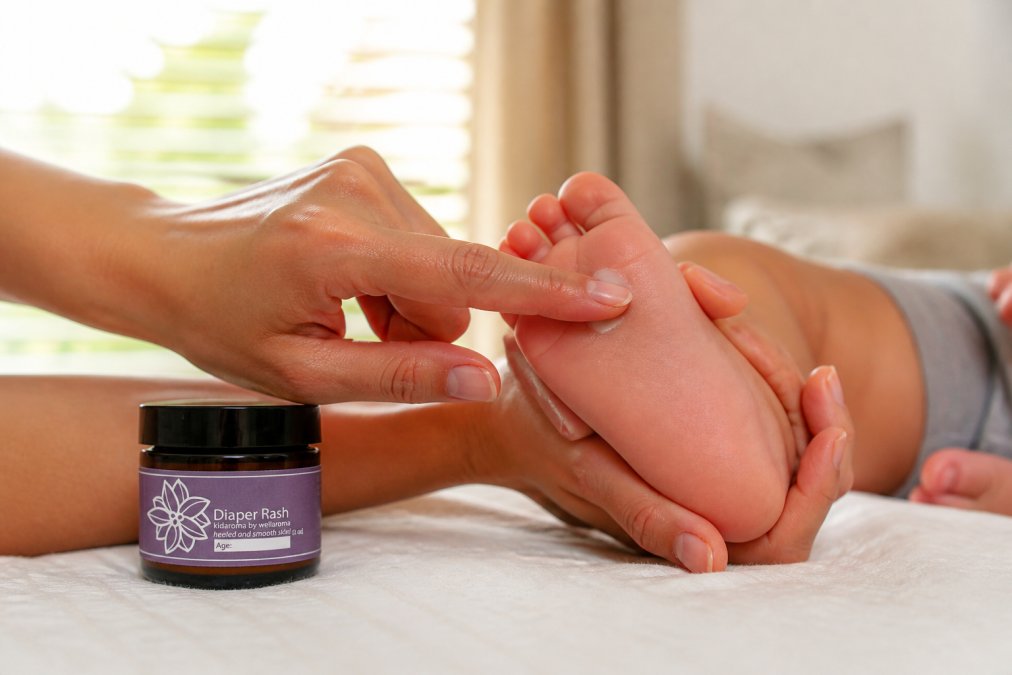
For creams and salves, use a small amount, about a pinkie-tip worth for infants and toddlers, a thumb-tip worth for older children. Apply to areas with thicker skin like feet, chest, or behind ears. Avoid thin-skinned areas like the face, inner wrists (except for patch testing), or diaper area.
Wellaroma's Diaper Rash cream is formulated at the correct dilution for your child's age. When you select your child's age at checkout, we prepare the cream at that specific dilution rate. For body oils, apply to small areas first, never across large body surface areas. A few drops rubbed into the feet or chest is appropriate.

Never apply diluted oils to broken skin, eczema patches, or areas of active inflammation without consulting a healthcare provider first.
Inhalation and Diffusion
Inhalation is safer than topical application for very young children because it avoids skin contact entirely. For infants and toddlers, run the diffuser for 15-30 minutes in a well-ventilated room. Never leave it running continuously. For school-age children, you can extend diffusion time to 45-60 minutes, but still prioritize ventilation.
Never add essential oils to a child's pillow, blanket, or clothing. The concentration becomes too high in the immediate breathing zone. Cold diffusion (ultrasonic) is safer than heat-based diffusion for children.
Patch Testing Before First Use
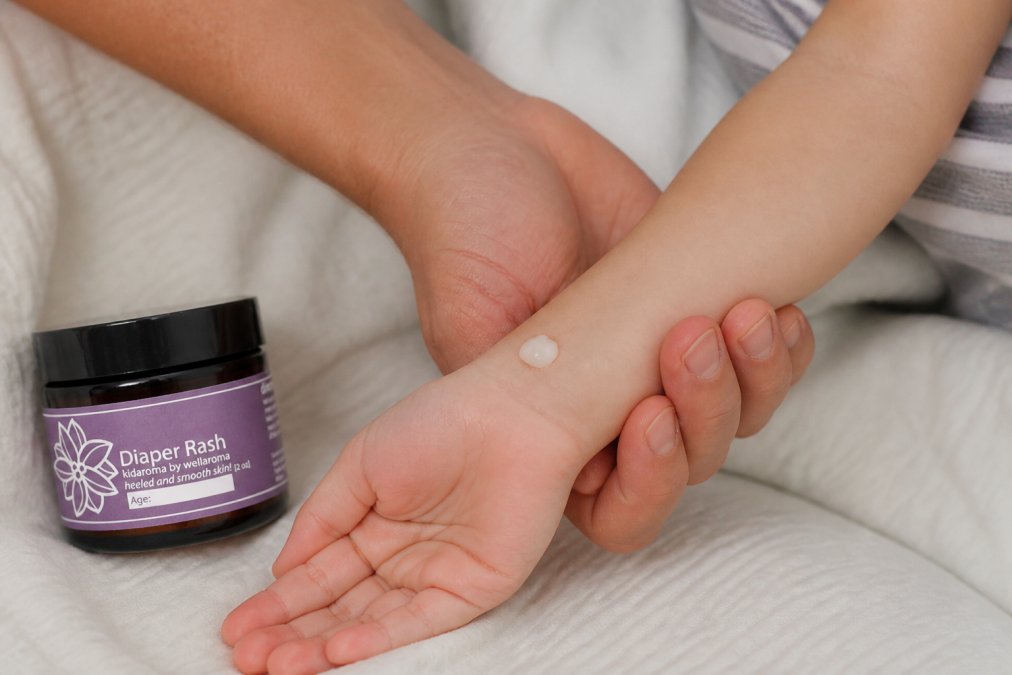
Patch testing is the single most important safety step before using any new essential oil product on a child.
-
Apply a small amount of the diluted essential oil (about the size of a pea) to a small, inconspicuous area of skin, typically the inner wrist, behind the ear, or inside the elbow.
-
Leave it undiluted for 24 hours. Do not wash the area.
-
Observe for any reaction: redness, itching, swelling, warmth, or discomfort.
-
If no reaction appears after 24 hours, the product is likely safe for your child.
If any reaction occurs, do not use the product on your child. Wash the area immediately and consider consulting a healthcare provider if the reaction is severe or doesn't resolve quickly.
Choosing the Right Carrier Oils for Children
The carrier oil you choose matters as much as the essential oil itself. Carrier oils dilute the essential oil, reduce concentration, and provide their own skin benefits.
Fractionated coconut oil is the most popular carrier oil for children. It's lightweight, absorbs quickly, doesn't leave a greasy residue, and has a naturally neutral scent. It's stable at room temperature and has a long shelf life.
Sweet almond oil is gentle and nourishing but carries a higher risk of allergic reaction in children with tree nut allergies. Jojoba oil closely mimics the skin's natural sebum, making it excellent for children with dry or sensitive skin. Grapeseed oil is lightweight and suitable for children.
Avoid mineral oil, baby oil, and petroleum-derived products. These are occlusive rather than nourishing. Avoid nut-based oils if your child has any known or suspected tree nut allergies.
Store carrier oils in cool, dark places. Most plant-based oils oxidize when exposed to heat and light, which can create irritating compounds.
Recognizing Adverse Reactions and When to Stop
Even with proper dilution and patch testing, some children will have adverse reactions to essential oils.
Mild reactions include localized redness, slight itching, or minor warmth at the application site. These often resolve within a few hours of washing the area. If a mild reaction persists beyond a few hours or worsens, wash thoroughly and discontinue use.
Moderate reactions include significant redness, swelling, intense itching, or a rash spreading beyond the application site. Wash the area immediately with gentle soap and cool water. Apply a plain carrier oil or moisturizer to soothe the skin. If the reaction doesn't improve within 2-4 hours or continues to worsen, contact a healthcare provider.
Severe reactions include blistering, significant swelling, difficulty breathing, or systemic symptoms like fever or nausea. These are rare with properly diluted oils but require immediate medical attention.
Photosensitivity reactions occur when a child is exposed to sunlight after topical application of photosensitive oils like lemon, grapefruit, or bergamot. These reactions appear as severe sunburn-like burns on exposed skin and are preventable by avoiding these oils entirely.
If your child develops any reaction, stop using the product immediately and wash the affected area thoroughly. Some children develop sensitivity over time, even to oils they've tolerated well previously. If your child's skin begins reacting to a product that previously worked fine, discontinue use and allow the skin to reset for a few weeks.
Keeping your child safe with essential oils comes down to three practices: dilute correctly for their age, patch test before first use, and watch for adverse reactions. These steps are the foundation of safe essential oil use in children.
Wellaroma has built every children's product around these principles. Our Bedtime Calm cream, Cold Free Kids formula, and Diaper Rash cream are all diluted at the appropriate concentration for your child's age. When you order, you select your child's age, and we prepare the product at that specific dilution. This eliminates the risk of over-concentration while ensuring you're getting a product potent enough to deliver real benefits.

Start with patch testing. Choose products formulated specifically for children. Watch your child's skin carefully. When you follow these steps, essential oils can be a safe, effective part of your family's wellness routine.
Frequently Asked Questions
What is the recommended dilution percentage for children by age?
Dilution percentages depend on age. Infants under 6 months should use 0.5-1% dilution. Toddlers (6 months-3 years) need 1-2% dilution. School-age children (3-12 years) can use 2-3% dilution. Always follow product-specific guidelines and patch test first. Wellaroma's pre-made products like Cold & Flu Away Kids are already diluted safely for your child's age when you select the correct age range at checkout.
Are essential oils safe for babies under 6 months?
Essential oils must be used very cautiously with infants under 6 months. Diffusion is generally safer than topical application at this age. Never apply undiluted essential oils to a baby's skin. If using diluted oils, the concentration should not exceed 0.5-1%. Many experts recommend waiting until 3-6 months before introducing any essential oil products. Consult your pediatrician before using essential oils on infants. Wellaroma's Bedtime Calm and other products allow you to specify your infant's age for proper dilution.
What essential oils should not be used on children?
Avoid eucalyptus globulus, peppermint, tea tree, wintergreen, thyme, oregano, lemon, and grapefruit oils on children under 10 years old. These oils can cause respiratory irritation, skin sensitization, or toxicity concerns in young children. Also avoid oils high in phenols or ketones, which pose greater risks to developing systems. Always check the essential oil safety profile and consult a qualified aromatherapist or pediatrician before introducing any new oil. Safe alternatives for children include lavender, chamomile, and palmarosa, which are gentler and well-documented for pediatric use.
What are the signs of an essential oil reaction in children?
Watch for redness, itching, burning, or rash at the application site; respiratory irritation such as coughing or wheezing; nausea, dizziness, or headache; or drowsiness and lethargy. If your child shows any of these symptoms, stop using the product immediately and rinse the area with carrier oil (not water). Seek medical attention if symptoms persist or worsen. Performing a patch test 24 hours before full application can help identify sensitivities early. Keep a record of which oils and products your child has used to identify patterns.
This article was written using GrandRanker

Leave a comment