


Safe Essential Oils for Babies: A Parent's Guide
Table of Contents
- Why Age and Dilution Matter for Essential Oils for Babies
- Safe Essential Oils for Babies by Age
- Essential Oils to Avoid for Newborns and Infants
- Essential Oil Dilution Chart for Babies
- How to Diffuse Essential Oils Safely for Infants
- Topical Application: Patch Tests and Carrier Oils
- Recognizing Allergic Reactions and Sensitization
- Storage, Shelf Life, and Environmental Safety
- Frequently Asked Questions
Last Updated: September 9, 2026
Why Age and Dilution Matter for Essential Oils for Babies
A newborn's skin is roughly 20-30% thinner than an adult's, and their liver enzyme systems are not fully mature until around three months of age. This is why the conversation about essential oils for babies must always start with age and dilution, using the wrong concentration can lead to skin irritation, respiratory distress, or lifelong sensitization.
At Wellaroma, we formulate every children's product with age-specific dilution rates because what is safe for a toddler is not automatically safe for a two-week-old, an infant's body absorbs and reacts to botanical compounds far more intensely than an adult's.
Most adverse reactions in infants are not caused by the essential oil itself, but by improper dilution ratios and inappropriate application methods. Pediatric organizations consistently caution that topical application and inhalation carry real risks when guidelines are ignored, and guidance from the American Academy of Pediatrics on complementary medicine emphasizes consulting a pediatrician before introducing any botanical product to a child under two years old.
Safe Essential Oils for Babies by Age
The safest approach to essential oils for babies follows a phased timeline that respects developmental milestones. Each phase expands what is permissible, but none removes the need for heavy dilution and careful observation.
0-3 Months: The 'Look, Don't Touch' Phase
During the first three months, the only truly safe approach is indirect exposure at extremely low concentrations, gentle diffusion in a large, well-ventilated room, never in the nursery while the baby is present.
Lavender and roman chamomile are the two oils most commonly tolerated at this stage, but only when diffused for short periods of 15-20 minutes before the baby enters the room. Topical application is not recommended because the skin barrier is still developing and the risk of sensitization is highest.
3-6 Months: Gentle Introduction
Once your baby crosses the three-month mark, the liver and skin have matured enough for very small topical amounts. A single drop of lavender diluted in one tablespoon of a gentle carrier oil is the maximum concentration most practitioners suggest.

The best use at this stage is supporting sleep routines. A trace amount of diluted lavender massaged into the soles of the feet before bedtime can be calming, but you should still avoid the face, hands, and chest. The hands end up in the mouth constantly, and the face has the most sensitive skin. Tisserand Institute safety guidelines on children and essential oils notes that dermal application in young children requires significantly lower concentrations than adult use.
6-12 Months: Expanding the Toolkit
Between six and twelve months, you can incorporate a broader range of oils, including sweet orange, mandarin, and cedarwood. The dilution ratio can increase slightly to one drop per two teaspoons of carrier oil, roughly a 0.5% concentration.
Essential Oils to Avoid for Newborns and Infants
Several essential oils should never be used around newborns or infants, regardless of dilution, including peppermint, eucalyptus, wintergreen, and any oil high in menthol or 1,8-cineole content. These compounds can trigger laryngospasm, a reflex closure of the vocal cords that can cause breathing difficulties.
Other oils to avoid entirely include clove, cinnamon, oregano, thyme, and all citrus oils expressed from the peel, such as bergamot and lime. These oils are either too harsh for immature skin or carry phototoxicity risks that cause severe reactions when skin is exposed to sunlight. The FDA information on essential oils and skin reactions highlights that phototoxic reactions from citrus oils can produce burns and hyperpigmentation.
Chemical Constituents That Cause Problems
Understanding why certain oils are unsafe comes down to their chemical makeup. Phenols and aldehydes, found in cinnamon, clove, and lemongrass, are strong skin irritants. Ketones, present in sage and wormwood, are potentially neurotoxic and should never be used with infants.
The safest oils for babies are those with high ester and monoterpene alcohol content, such as lavender, roman chamomile, and sweet orange. These are gentle, anti-inflammatory, and metabolize quickly without taxing an infant's liver. When in doubt, skip it.
The Hidden Danger: Cross-Species Toxicity in the Nursery
A critical safety dimension that most articles ignore is the presence of pets in the nursery. Many parents use diffusers in the same room where a cat or dog sleeps, unaware that an oil safe for a human infant can be lethal to a pet. Cats are especially vulnerable because they lack the specific liver enzyme (glucuronosyltransferase) needed to metabolize many aromatic compounds, particularly phenols and ketones. ASPCA guidance on essential oils and pets warns that even passive diffusion of certain oils can cause liver failure in felines.
Oils to Never Diffuse or Apply in a Home with Cats:
- Peppermint, wintergreen, and eucalyptus: These contain high levels of phenols and methyl salicylates that cats cannot process, leading to vomiting, tremors, and potentially fatal liver damage.
- Tea tree (melaleuca): Even a few drops of undiluted tea tree oil on a cat's skin can cause severe neurological symptoms, including ataxia and seizures. Diffusing it in a closed room is equally risky.
- Citrus oils (lemon, orange, bergamot): The d-limonene content is toxic to cats and can cause drooling, weakness, and respiratory distress.
Oils to Use with Extreme Caution Around Dogs:
- Tea tree and wintergreen: Dogs are more tolerant than cats but still at risk for toxicity, especially with repeated exposure. The ASPCA Animal Poison Control guidance on essential oil toxicity notes that concentrated tea tree oil can cause skin burns and neurological issues in canines.
Practical Rules for Pet-Safe Diffusion:
- Never diffuse in a room where a cat is present. Even if the cat is in another room, HVAC systems can carry the mist. Use a dedicated nursery diffuser and keep the door closed.
- Choose pet-safe oils only. If you must diffuse, lavender and roman chamomile are generally considered safer for both cats and dogs at very low concentrations, but always monitor your pet for signs of distress (excessive drooling, lethargy, or hiding).
- Ventilate thoroughly. After the 15-20 minute diffusion cycle, open a window for at least 10 minutes before allowing pets back into the space.
Essential Oil Dilution Chart for Babies
A precise dilution chart is the most important tool a parent can have. Unlike adults who can tolerate 2-5% concentrations, babies need fractions of that amount. The table below shows safe dilution ratios by age.
| Age Group | Dilution Ratio | Drops per Carrier Oil | Safe Application |
|---|---|---|---|
| 0-3 months | None (diffusion only) | 0 drops | 15-20 min diffusion in empty room |
| 3-6 months | 0.25% | 1 drop per 4 tsp | Soles of feet only |
| 6-12 months | 0.5% | 1 drop per 2 tsp | Soles, back, lower legs |
| 1-2 years | 0.5-1% | 2-3 drops per 2 tsp | Full body, avoid face |
Cold-pressed and steam distilled oils are preferred because they retain pure botanical compounds without synthetic additives. Fractionated coconut oil and jojoba oil make excellent carrier oils, they are lightweight, non-comedogenic, and closely mimic the skin's own sebum.
How to Diffuse Essential Oils Safely for Infants
Diffusing is the safest delivery method for essential oils for babies under three months, but only with the same precision you'd use for a medication. The goal is a barely perceptible ambient scent, not a fragrant room, overexposure through diffusion is a leading cause of respiratory irritation in infants. skincare for newborns.
The 15-20 Minute Rule and Room Volume
Set the diffuser to run for a maximum of 15-20 minutes in the baby's room, then turn it off and allow the aroma to fully dissipate before bringing the baby into the space. This is a hard limit. In a standard 10x10-foot nursery with 8-foot ceilings (roughly 800 cubic feet), a single 15-minute cycle of a 0.25% dilution leaves a trace scent that is generally tolerable. In a smaller space, reduce the diffusion time to 10 minutes. Diffusing while the baby is in the room can overwhelm their respiratory system. Always leave a window slightly open or a door ajar.
Why Continuous Diffusion Is Harmful
Running a diffuser all night is counterproductive and potentially harmful. Continuous exposure to volatile organic compounds (VOCs), even natural ones, can irritate an infant's delicate nasal passages and airways, leading to congestion, coughing, or disrupted sleep. The goal is to create a memory of the scent, not a constant cloud.
Diffuser Types and Placement
Ultrasonic diffusers are the best choice for nurseries because they disperse a fine mist without heat. Nebulizing diffusers atomize pure oil into a concentrated vapor and are too strong for infant spaces, and heat-based plug-in or candle diffusers can alter the oil's chemical structure.
Place the diffuser at least six feet away from the crib and never directly above it, a dresser or shelf across the room is ideal. If you have a central HVAC system, avoid placing the diffuser near an intake vent, as this will distribute the oil throughout the entire house.
The 'Pre-Scent' Technique for Sleep
A more effective and safer approach for sleep support is the 'pre-scent' technique. Run the diffuser for 15 minutes in the nursery with the door closed, then turn it off and allow the room to air out for 10-15 minutes before placing the baby down. This leaves a subtle trace of the oil that can cue a sleep association without a concentrated burst of aromatic compounds.
Topical Application: Patch Tests and Carrier Oils
Before any topical use of essential oils for babies, a patch test is non-negotiable. Even with correct dilution, individual sensitivities exist, and a patch test is the only way to predict a reaction safely.
Apply a small amount of the diluted oil to a quarter-sized area on the baby's inner arm or back of the calf. Cover with a bandage and wait 24 hours. If any redness, swelling, itching, or rash develops, wash the area with mild soap and water and do not use that oil again.
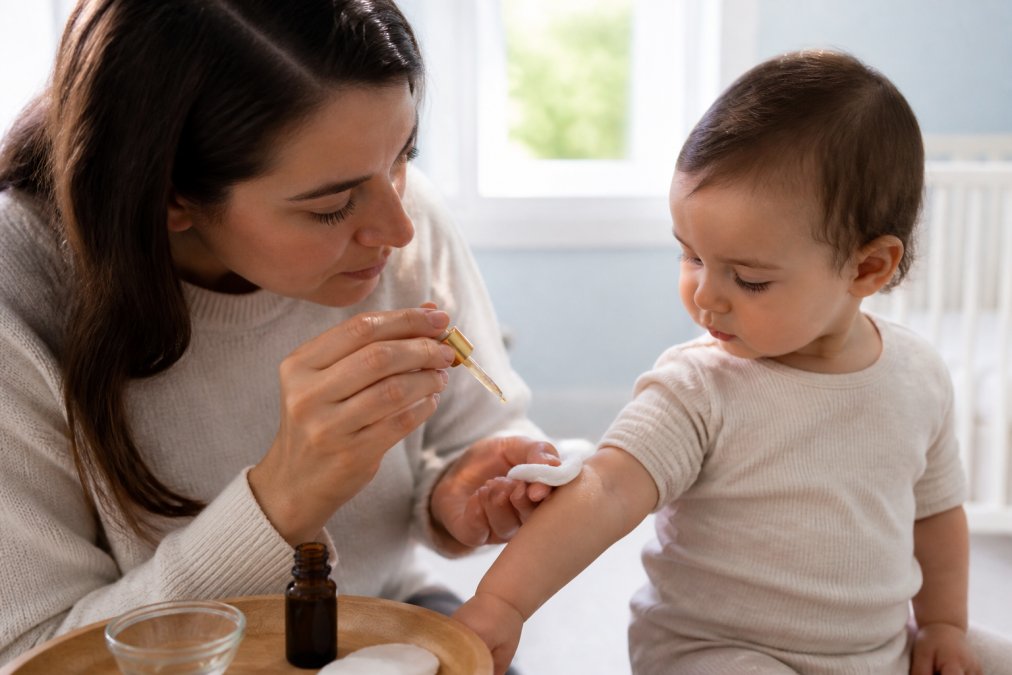
For babies with sensitive or dry skin, carrier oil selection matters as much as the essential oil itself. Fractionated coconut oil, jojoba oil, and sweet almond oil are the most gentle options. Avoid mineral oil and heavily processed vegetable oils, which sit on the skin without penetrating.
Recognizing Allergic Reactions and Sensitization
Even with proper dilution, allergic reactions can occur. Signs to watch for include redness or hives at the application site, excessive fussiness, wheezing or coughing, and changes in breathing patterns. Skin sensitization can develop over time, meaning a product used safely for weeks suddenly triggers a reaction.
Sensitization often appears as a delayed eczema-like rash, dry patches, or increased skin sensitivity. If you notice any of these symptoms, discontinue use immediately and consult your pediatrician. Keep a record of which oils you have used and in what concentrations.
Storage, Shelf Life, and Environmental Safety
Essential oils degrade over time, and oxidized oils are more likely to cause skin irritation. Most pure essential oils have a shelf life of one to three years when stored properly, keep bottles in a cool, dark place and always replace the cap immediately after use to prevent oxidation.
Environmental safety also extends to pets. Cats lack the liver enzymes to metabolize many essential oil compounds, particularly phenols and ketones, and ASPCA guidance on essential oils and pets warns that diffusing certain oils can be toxic to felines. If you have cats, restrict diffusion to rooms they cannot access, or choose only pet-safe oil options.
When selecting products for your baby, look for brands that disclose their dilution rates and ingredient sourcing. Wellaroma formulates children's products like the Baby Butter - Hint of Lavender and the Diaper Rash (Healed Bottom) cream with age-specific dilution rates selected at checkout.

Choosing to use essential oils for babies is a decision that rewards caution. With age-appropriate dilution, careful patch testing, and conservative diffusion practices, botanical support can be a gentle addition to your family's wellness routine. Wellaroma builds every children's product with age-matched dilution and organic, skin-safe ingredients, explore the children's collection and find the right formulation for your little one's needs.
Frequently Asked Questions
What oil can I put in a humidifier for my baby?
For a humidifier, it's best to use only water. Humidifiers are designed to add moisture to the air, and adding essential oils can damage the unit and disperse oil particles improperly. For aromatherapy, use a dedicated ultrasonic diffuser instead. If you choose to diffuse essential oils for babies, always use a cool-mist diffuser placed out of reach, and run it for short intervals of 15-20 minutes in a well-ventilated room.
How do I properly dilute essential oils for infants?
For infants 3-6 months, use a 0.25% dilution ratio, which is about 1 drop of essential oil per 4 teaspoons (20 ml) of carrier oil. For babies 6-12 months, a 0.5% dilution is appropriate, which is 1 drop per 2 teaspoons (10 ml) of carrier oil. Always use a gentle carrier oil like fractionated coconut oil or jojoba oil and perform a patch test 24 hours before full application.
Which essential oils should be avoided around babies?
Avoid peppermint, eucalyptus, wintergreen, and camphor around infants under 2 years old, as they can cause respiratory distress. Also skip rosemary, clary sage, and citrus oils like bergamot, which can cause phototoxicity or skin sensitivity. Skip synthetic blends and always choose pure essential oils from reputable sources. When in doubt, consult your pediatrician before introducing any new oil.
Are essential oils safe to diffuse in a nursery?
Yes, with strict precautions. Use an ultrasonic diffuser placed on a high shelf out of your baby's reach. Add only 1-2 drops of a gentle oil like lavender or roman chamomile to the water. Diffuse for no more than 15-20 minutes, and stop if your baby coughs or seems irritated. Keep the nursery well-ventilated and never diffuse while your baby is sleeping in the room for extended periods.
At what age can you start using essential oils on a baby?
Most experts recommend waiting until a baby is at least 3 months old before any topical application. For the first 3 months, stick to indirect inhalation, such as diffusing lavender in a nearby room. Even after 3 months, use only gentle oils at a very low dilution (0.25%). Always consult your pediatrician before starting any essential oil routine. Wellaroma's baby products are pre-diluted based on your child's age range.
What are the signs of an allergic reaction to essential oils in babies?
Watch for redness, hives, or a rash at the application site, which indicates contact dermatitis. Respiratory signs include coughing, wheezing, or difficulty breathing. Your baby might also seem unusually fussy or lethargic. If you see any of these signs after using essential oils, wash the area with mild soap and water and stop using the oil. Seek immediate medical help if breathing is affected.

Leave a comment