


Organic Aromatherapy Survival Kit for Home: Review
Table of Contents
- What Belongs in an Organic Aromatherapy Survival Kit for Home
- Essential Oil First Aid Kit Checklist for Home Emergencies
- Wellaroma Diffusers and Singles: What the Kit Actually Costs
- Aromatherapy for Stress and Anxiety at Home: Rollers and Blends
- Essential Oil Safety Guidelines for Families
- Travel Kits vs. Home-Base Kits: What Changes
- Verdict: Is the Organic Aromatherapy Survival Kit Worth It?
- Frequently Asked Questions
Last Updated: September 16, 2026
What Belongs in an Organic Aromatherapy Survival Kit for Home
An organic aromatherapy survival kit for home is a curated set of pure essential oils, a diffuser, and pre-diluted rollers covering first aid, stress relief, and sleep support in one place. At Wellaroma, we specialize in natural and organic body care products, offering essential oil healing solutions designed for the whole family. Prioritizing these plant-derived extracts ensures that your living space remains free from harsh chemicals while you explore natural fragrance alternatives to enhance your daily wellness routine.
Diffuser, Oils, and Rollers: The Three Core Pieces
Every functional kit rests on three components. Skip one and you lose a whole category of use.
- A diffuser handles room-level support: calming a household before bed, clearing a sickroom, or setting a focused tone for homework.
- Single oils give you flexibility. Lavender, peppermint, and frankincense each serve different purposes, and blending them yourself covers more ground than any pre-mixed bottle.
- Pre-diluted rollers are the grab-and-go layer. No measuring, no carrier oil, no guesswork when you're tired or tending a cranky child.
Essential Oil First Aid Kit Checklist for Home Emergencies
A working essential oil first aid kit checklist is short and specific. Here is the version we recommend.

Core kit:
- One ultrasonic diffuser with a timer
- Lavender for calming and skin support
- Peppermint for head tension relief and focus
- Frankincense for grounding and respiratory comfort
- Roman chamomile for sensitive skin and restlessness
- One de-stress roller for daytime tension
- One sleep roller for bedtime
- A carrier oil for dilution
- Adhesive bandages, gauze, and antiseptic wipes
Nice to have:

- Basil for digestive discomfort
- Nasal inhalers for travel
- A small spray bottle with liquid castile soap for a DIY surface disinfectant
Wellaroma Diffusers and Singles: What the Kit Actually Costs
Building a kit yourself costs less than most pre-assembled boxes, and you end up with oils you'll actually use. Here is our catalog pricing.
GreenAir Aroma Cloud Diffuser Review
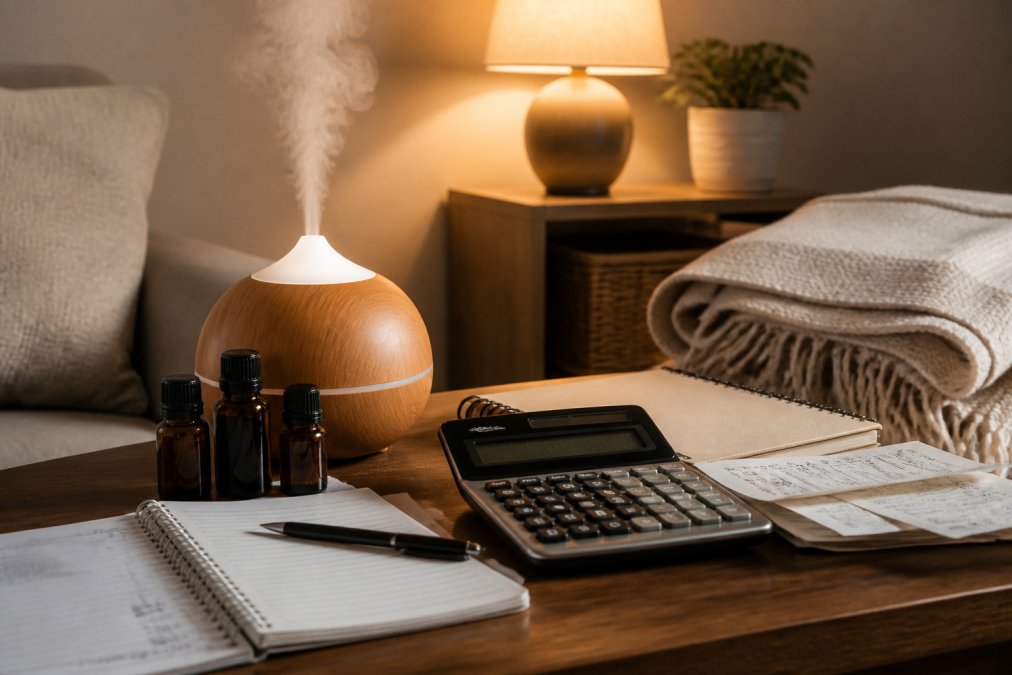
At $59.99, the GreenAir Aroma Cloud is the anchor of the kit. It runs up to 10 hours continuous or 24 hours intermittent, covers up to 1,000 square feet, and holds 250ml of water. The faux wood finish blends into a living room or bedroom rather than announcing itself as a gadget.
Single Oils: Lavender, Peppermint, Frankincense, and More
| Oil | Price | Origin | Best For |
|---|---|---|---|
| Lavender Organic (14.79ml) | $14.50 | USA | Calming, skin support, sleep |
| Peppermint | $12.49 | USA | Head tension, focus, cooling |
| Frankincense | $34.99 | Somalia | Grounding, respiratory comfort |
| Roman Chamomile (15ml) | $38.29 | USA | Sensitive skin, restlessness |
| Basil (14.79ml) | $13.75 | France | Digestive discomfort |
Lavender is the workhorse. It blends well with most oils, making it the first bottle to buy if you're starting from nothing. Peppermint at $12.49 is the cheapest entry point and the one you'll reach for during a long afternoon. Frankincense costs the most because resin-sourced oils take more plant material to produce, and the clean, earthy profile is worth it if you use it regularly.

Aromatherapy for Stress and Anxiety at Home: Rollers and Blends
Aromatherapy for stress and anxiety at home works best when the delivery method matches the moment: rollers for on-body use, diffusers for the room, blends when you want both.
Essential Oil Safety Guidelines for Families
Essential oil safety guidelines for families come down to four habits: dilute correctly, patch test, know which oils are off-limits for kids, and plan for pets.
Dilution, Patch Testing, and Kid-Safe Limits
Dilution is the non-negotiable one.
Patch testing takes a day. Apply a small amount of the diluted oil to the inner forearm, wait 24 hours, and check for redness or itching. Do this with every new oil before using it on a child, and re-test if you switch carrier oils.
Pet Safety: The Gap Most Guides Skip
Practical rules that hold up in a home emergency:
- Diffuse only in a space your pets can leave. Keep the door open and never run a diffuser in a crate, carrier, or closed bedroom where an animal is confined.
- Never apply oils to an animal's coat or paws, and never add them to drinking water.
- If you're evacuating with pets, leave the diffuser behind and bring the rollers instead, but keep the rollers sealed and out of reach, since a punctured roller in a hot car can leak onto a pet.
- If a pet shows drooling, wobbliness, vomiting, or lethargy after oil exposure, call your veterinarian or a pet poison hotline immediately.
Travel Kits vs. Home-Base Kits: What Changes
A travel kit and a home-base kit serve different jobs, and the difference is mostly weight, shelf stability, and how each pairs with standard first aid supplies.
The Home-Base Kit
Your home kit can be generous because it stays in one place. A working version:
- One ultrasonic diffuser with a timer, positioned centrally in the room you use most
- Five or six single oils: lavender, peppermint, frankincense, roman chamomile, and one or two specialty oils your household actually reaches for
- Both rollers (de-stress and sleep)
- A carrier oil
- Adhesive bandages, gauze pads, medical tape, and antiseptic wipes stored in the same bin
The Travel and Evacuation Kit
A travel kit needs to fit in a bag and survive temperature swings: rollers over glass dropper bottles, nasal inhalers over a diffuser, and a pared-down oil selection. Lavender, peppermint, and one calming blend cover most situations on the road.
How the Two Kits Pair With Standard First Aid
Think of the aromatherapy kit as a layer beside your first aid supplies, not on top of them.
- Cuts and scrapes: clean and cover with standard supplies first. A diluted lavender roller can be used on intact skin around the area afterward, but never on an open wound.
- Insect bites and rashes: a cool compress plus a diluted lavender or roman chamomile roller on intact skin. If the bite is swelling, spreading, or warm to the touch, that's a medical issue, not an aromatherapy one.
- Stress and sleep during an emergency: this is where the kit earns its place. Rollers and inhalers work when the power is out, when you're in a shelter, and when a diffuser isn't an option.
- Head tension: a diluted peppermint roller on temples and the back of the neck, kept well away from the eyes.
Verdict: Is the Organic Aromatherapy Survival Kit Worth It?
Yes, if you build it around the three core pieces and use it. A complete Wellaroma-based kit runs roughly $130 to $180 depending on which singles you choose, covering first aid support, daily stress management, and sleep in one box.
Frequently Asked Questions
What should go in an organic aromatherapy survival kit for home?
A working kit needs three things: a diffuser, two or three single oils, and one or two pre-diluted rollers. The GreenAir Aroma Cloud Diffuser covers up to 1000 sq. ft. and runs up to 10 hours continuous, so it handles a living room or bedroom. Pair it with Lavender Organic ($14.50) for calming, Peppermint ($12.49) for head tension, and Frankincense ($34.99) for grounding. Add the Zen roller ($14.99) for stress and the Restful Sleep roller ($13.99) for bedtime. That covers most everyday home needs without overbuying.
Are organic aromatherapy kits safe for children and pets?
Dilution matters most. Wellaroma's single oils are labeled ready to diffuse but must be diluted for skin use. For children, use a lower dilution than adult strength and always patch test first. Keep diffusers out of reach and ensure pets can leave any room where a diffuser is running. If a child or pet shows irritation, stop use and ventilate the room. Consult a pediatrician or veterinarian before using essential oils around young children or pets, especially if they have breathing conditions.
How do you store organic essential oils for long-term use?
Keep bottles in a cool, dark place with the cap tight. Amber glass, like the 14.79ml and 15ml singles from Wellaroma, blocks light that breaks down oils over time. Avoid bathroom shelves where heat and humidity fluctuate. Most citrus oils lose potency faster than resin oils like Frankincense, so rotate those first. A small wooden box in a closet works well. If a bottle smells flat or sharp instead of its usual scent, replace it rather than adding more to a blend.
What is the difference between therapeutic grade and organic essential oils?
Therapeutic grade is a marketing term, not a regulated one, so it means whatever the seller says. Organic refers to how the plants were grown and is verifiable through certification. Wellaroma sources from environmentally conscious farms and lists origin and plant part on each bottle, such as Lavender from flowering tops grown in the USA or Frankincense resin from Somalia. That transparency tells you more than a grade label. Look for origin, plant part, and whether the oil needs dilution before use.
Can aromatherapy help with stress during a home emergency?
Scent can support calm, but it is not a treatment. The Zen roller ($14.99) blends frankincense, geranium, lavender, mandarin orange, and marjoram, and its label directs you to roll it on shoulders, temples, and pulse points. For sleep disruption during stressful periods, the Restful Sleep roller ($13.99) combines bergamot, marjoram, roman chamomile, lavender, and vetiver, applied to the soles of the feet and pulse points an hour before bed. Use these alongside, not instead of, standard first aid and emergency supplies.
Households that plan ahead handle stressful nights better than those that don't. Wellaroma builds organic aromatherapy survival kits around pure, therapeutic grade oils sourced from environmentally conscious farms, with rollers and blends designed for real family use. Start with the GreenAir Aroma Cloud Diffuser and a core set of singles, add the Zen and Restful Sleep rollers, and you have a kit that earns its shelf space. Add to cart and build yours today.

Leave a comment