


How to Create Custom Essential Oil Perfumes
Table of Contents
- Understanding Fragrance Notes and How to Create Custom Essential Oil Perfumes
- Essential Oil Dilution for Skin Safety
- Choosing Your Base: Carrier Oil vs. Perfumer's Alcohol
- Essential Oil Blending for Beginners: A Step-by-Step Formula
- Essential Oil Perfume Recipes You Can Make Today
- Using an Essential Oil Perfume Roller for On-the-Go Fragrance
- Maturation, Testing, and Troubleshooting Your Blend
- Conclusion
- Frequently Asked Questions
Last Updated: October 17, 2026
Understanding Fragrance Notes and How to Create Custom Essential Oil Perfumes
Creating custom essential oil perfumes starts with fragrance's three layers, top, middle, and base notes, each shaping how your perfume smells over time.
Top notes hit first and fade fast; middle notes are the heart, defining the scent; base notes are the foundation, giving staying power.
At Wellaroma, we offer quality essential oils for crafting signature scents. Understanding these three layers is the key to a perfume that smells good from first spray to last drop.
Top Notes: Your First Impression
Top notes are the first thing you smell, bright, fresh, and energetic, but they last only 5 to 15 minutes.
They're typically citrus, herbal, or spicy oils like lemon, bergamot, basil, or ginger, which evaporate quickly.

When you're blending, use 20 to 30 percent top notes in your formula. They set the mood but shouldn't dominate your final scent.
Middle Notes: The Heart of Your Blend
Middle notes emerge as top notes fade, forming your fragrance's main character and lasting 20 minutes to several hours.
They tend to be floral, fruity, or spicy, ylang ylang, lavender, rose, and cinnamon are popular, and evaporate more slowly.
Use 50 to 60 percent middle notes. This is where your signature scent comes alive, often what people remember about your fragrance.
Base Notes: Longevity and Depth
Base notes are your fragrance's foundation, emerging last and lingering longest, sometimes for hours.
They're usually woody, earthy, or resinous, sandalwood, vetiver, and cedarwood are classic, and evaporate slowly, anchoring the blend.
Use 10 to 20 percent base notes in your formula. Even a small amount creates depth and helps your perfume last on the skin.
Essential Oil Dilution for Skin Safety
Never apply pure essential oil directly to skin. These concentrated extracts can cause irritation, burning, or allergic reactions, and safe limits vary by oil, a perfume fine for one person can sensitize another.
Start With a Concentration, Then Do the Math
For leave-on perfume applied to pulse points, most practitioners work in the 1-3% range for the total essential oil blend, not per oil. Here is how that translates into measurable amounts:
| Finished perfume size | 1% dilution | 2% dilution | 3% dilution |
|---|---|---|---|
| 5 mL (small roller) | ~3 drops | ~6 drops | ~9 drops |
| 10 mL (standard roller) | ~6 drops | ~12 drops | ~18 drops |
| 30 mL (1 oz spray) | ~18 drops | ~36 drops | ~54 drops |
| 100 mL (3.4 oz spray) | ~60 drops | ~120 drops | ~180 drops |
These counts assume roughly 20 drops per milliliter. Because drop size varies, confirm with a scale: 1 mL of essential oil weighs close to 0.9 g, so a 2% blend in a 10 mL batch is about 0.18 g of total essential oil.
Oil-Specific Limits Matter
Not all oils belong at the same percentage. A few widely used examples illustrate the range:
- Citrus oils (lemon, bergamot, sweet orange, grapefruit): Many are phototoxic, meaning they can make skin more reactive to sunlight and cause burns or dark patches. Bergamot, in particular, is commonly restricted to very low levels in leave-on products, often well under 1% of the finished product, and cold-pressed bergamot is the form to watch. If you want a bergamot note in a sun-exposed perfume, look for bergapten-free (FCF) bergamot.
- Cinnamon, clove, and other spice oils: These are strong skin sensitizers. Use them sparingly, often at 0.5% or less of the finished product, and never as a large share of the blend just because they smell warm.
- Ylang ylang, sandalwood, cedarwood, vetiver: Commonly used at typical perfume levels, though ylang ylang can be sensitizing for some people at higher concentrations.
A practical rule: keep any single strongly sensitizing or phototoxic oil to a small fraction of your total essential oil blend, and keep the total blend within the 1-3% range for leave-on skin use.

Patch Test Properly
A patch test is more than a dab on the wrist. Apply a small amount of the finished, diluted perfume to the inner forearm, cover it, and leave it 24 hours. Check for redness, itching, swelling, or burning; if you react, don't use that blend on skin. Repeat with any new batch, since a different oil or concentration can change the result.
Sensitization Is Cumulative
Allergic sensitization can develop over repeated exposure, an oil that caused no reaction ten times can trigger one later. Keep concentrations modest, rotate fragrances, and stop using any blend that starts to irritate.
Choosing Your Base: Carrier Oil vs. Perfumer's Alcohol
Your base changes how your perfume performs. Carrier oil and perfumer's alcohol each have pros and cons.
The downside: they can stain clothing, feel heavy in warm weather, and oxidize over time, which can change the scent.
The downside: alcohol-based perfumes dry out skin and fade faster than oil bases, so you'll need to reapply more often.
For beginners, we recommend starting with a carrier oil. It's gentler on skin and easier to work with.
Essential Oil Blending for Beginners: A Step-by-Step Formula
Here's a simple formula for your first custom fragrance, making one ounce of perfume.
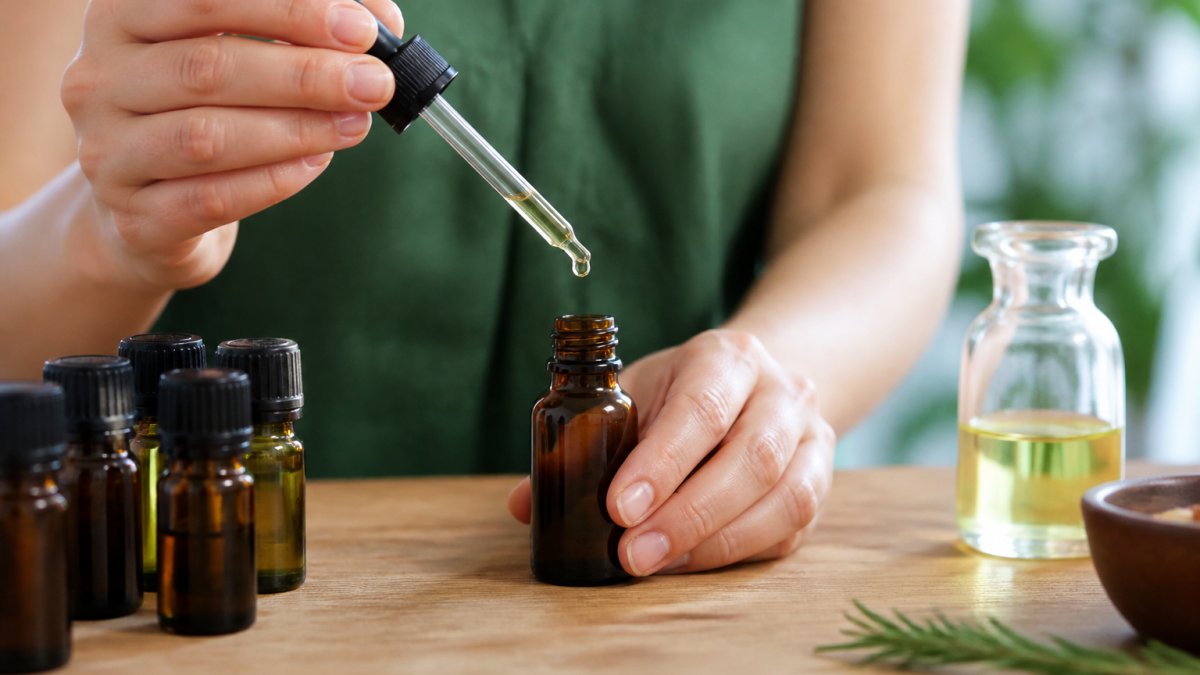
What You'll Need:
- 1 ounce of carrier oil (jojoba or fractionated coconut oil)
- 6 drops of top note oil
- 10 drops of middle note oil
- 3 drops of base note oil
Step 1: Choose Your Oils Pick one top, one middle, and one base note.
Step 4: Add Your Middle Note Add 10 drops of middle note oil and swirl again.
Step 6: Let It Rest Cap your bottle and let it sit 48 hours.
Step 7: Test on Skin Apply a small amount to your inner wrist.
Essential Oil Perfume Recipes You Can Make Today
Here are three ready-to-blend recipes. Each uses the same 1-ounce formula.
Recipe 1: Fresh Citrus Blend
- 6 drops lemon (top note)
- 10 drops sweet orange (middle note)
- 3 drops cedarwood (base note)
This blend is bright, uplifting, and clean. It's perfect for daytime wear.
Recipe 2: Floral Romance
- 6 drops bergamot (top note)
- 10 drops ylang ylang (middle note)
- 3 drops sandalwood (base note)
This blend is warm, sensual, and romantic. It works well for evening.
Recipe 3: Herbal Green
- 6 drops basil (top note)
- 10 drops lavender (middle note)
- 3 drops vetiver (base note)
This blend is earthy, calming, and herbaceous. It's ideal for relaxation.
Wellaroma offers quality essential oils like basil and ylang ylang that work beautifully in these blends.
Using an Essential Oil Perfume Roller for On-the-Go Fragrance
A perfume roller bottle makes your custom scent portable, small, easy to carry, and perfect for touch-ups.
Roller bottles hold about 10 milliliters and are ideal for wrists, neck, and behind the ears, the warmest spots where fragrance projects best.
The benefit of a roller: you apply exactly what you need without waste.
Wellaroma's custom roller bottles are designed to hold your blended oils. A custom roller costs $10.00.
Maturation, Testing, and Troubleshooting Your Blend
After you blend, the perfume is not finished, it is still settling. Maturation (sometimes called maceration) lets the oils marry, softens sharp edges, and reveals whether your note ratios actually work. Testing and adjusting during this window is what separates a reproducible custom perfume from a one-off experiment.
What Maturation Actually Does
When you combine top, middle, and base notes, the most volatile molecules evaporate first and the heavier ones unfold more slowly. Over the first days and weeks, sharp top notes round off, middle notes come forward, and base notes deepen.
A common timeline:
- Day 1: Oils are fresh and separate. Top notes dominate; the blend may smell sharp or disjointed.
- Days 2-3: The oils begin to marry. The scent smooths out and the middle notes become more legible.
- Week 1: The fragrance reaches a stable, representative state. This is the earliest point to judge balance.
- Weeks 2-4: Base notes become more prominent and the scent deepens. Some blends continue to shift subtly for a month or more.
Let an oil-based perfume rest at least 48 hours before judging it, and ideally a week before making major changes.
Test Like a Perfumer
Smelling straight from the bottle tells you little. Apply a small amount to skin and evaluate at intervals:
- Immediately (0-5 minutes): What hits first? This is your top-note impression.
- 30 minutes: The heart should be emerging. Is it balanced, or is one note shouting over the others?
- 2 hours: The base should be settling in. Does the fragrance still have presence, or has it gone flat?
- 4-6 hours: Check longevity. How close to the skin is it now?
Write down what you smell at each stage. Comparing notes across batches is how you learn your own preferences and your oils' behavior.
Diagnose and Adjust With Ratios, Not Guesswork
When a blend misses, change one variable at a time and keep the total essential oil percentage constant so you are adjusting balance, not strength.
- Too harsh or sharp: The top notes or a strong spice oil are dominating. Reduce the top-note share by about a third (for example, from 6 drops to 4 in a 1-ounce batch) and increase the middle note slightly to compensate. If a spice oil is the culprit, cut that oil specifically rather than the whole top-note category.
- Fades too fast: Top notes are carrying too much of the impression and the base is too thin. Shift the ratio toward the base, add 1-2 drops of base note and reduce top notes by the same count, and consider a fixative base oil such as sandalwood, vetiver, or a resinous note.
- Smells flat or one-dimensional: The blend lacks contrast. Add a small amount of a contrasting note (a citrus top against a woody base, or a floral middle against an earthy base) rather than simply increasing everything.
- Smells different after a week: This is normal maturation, not a failure. Re-test at the one-week mark before reformulating. If it has become too heavy, reduce the base note in the next batch.
Conclusion
Creating custom essential oil perfumes is easier than you think. Start with the three-note structure, follow a simple formula, and let your blend mature. Test on skin, adjust if needed, and enjoy your signature scent.
At Wellaroma, we believe everyone deserves a fragrance that feels personal. Our quality essential oils like ylang ylang, basil, and neroli are sourced from environmentally conscious farms and ready to blend.

Frequently Asked Questions
How many drops of essential oil should I use in a perfume roller?
For a 10ml roller bottle, use 15-20 drops of essential oil diluted in carrier oil. This creates a safe concentration (3-5%) suitable for direct skin application. Start with fewer drops if you have sensitive skin, and always perform a patch test on your inner wrist 24 hours before full application. Wellaroma's Custom Roller ($10.00) is designed to hold this exact ratio, making it simple to apply your custom blend throughout the day.
What's the safest dilution ratio for essential oil perfume on skin?
A safe dilution for body application is 3-5% essential oil to carrier oil. For a 10ml bottle, this means 3-5 drops per milliliter of carrier oil. Never apply undiluted essential oils directly to skin, as they can cause irritation or sensitization.
How long should homemade essential oil perfume sit before I use it?
Allow your perfume blend to rest for 48 hours to 2 weeks before wearing. During this maturation period, the fragrance notes marry and develop a more harmonious scent. Oil-based perfumes benefit from longer aging; alcohol-based versions can be used sooner. Store in a cool, dark place during maturation to prevent oxidation and preserve the integrity of your blend.
Which essential oils work best together for a signature scent?
Start by selecting one oil from each note category: a citrus or herbal top note (like basil), a floral middle note (like ylang ylang), and a woody or spicy base note. Wellaroma's Basil ($13.75), Ylang Ylang ($19.99), and Neroli ($73.59) blend beautifully together, creating a warm, exotic fragrance. Test small batches (5ml) before committing to larger quantities, adjusting the ratio until the scent feels balanced and personal to you.

Leave a comment