


Essential Oils for Emotional Balance: How to Use Blends
Table of Contents
- How Essential Oils for Emotional Balance Work
- Essential Oils for Anxiety: Calming Options to Try
- Essential Oils for Calmness: Grounding Scents for Overwhelming Days
- Essential Oils for Emotional Release: Working Through Stuck Feelings
- How to Use Essential Oil Blends: Step-by-Step Routines
- Choosing Quality Oils and Tracking What Works
- When to Seek Professional Mental Health Support
- Frequently Asked Questions
Last Updated: October 9, 2026
How Essential Oils for Emotional Balance Work
Essential oils for emotional balance are concentrated plant extracts that you inhale or apply to the skin to support a steadier mood. They do not cure anything, but many people find them a calming part of a daily routine. At Wellaroma, we build our blends around that idea: scent as a simple, gentle tool for emotional support. Integrating these aromatic practices alongside natural stones for balance can further ground your sensory experience and deepen the sense of calm you cultivate throughout the day.
The Sense of Smell and the Limbic System
Your sense of smell is the only sense that bypasses the brain's relay station and plugs straight into the limbic system (Olfactory memory networks: from emotional learning to social behaviors). That's the area tied to emotion and memory. This is why one whiff of a familiar scent can shift how you feel in seconds.
A few slow breaths from an open bottle or a diffuser can change the tone of a room. Skin application always needs dilution first.
Essential Oils for Anxiety: Calming Options to Try
Lavender, chamomile, and clary sage are often chosen for their soft, soothing scents.
Lavender, Chamomile, and Clary Sage
- Lavender is the classic calming oil. Its gentle floral scent makes it an easy first pick.
- Roman chamomile is sweet and mild. It suits people who find lavender too strong.
- Clary sage is earthy and herbal. It's a common choice for winding down at night.
You'll find all three in our National Center for Complementary and Integrative Health overview of aromatherapy guide to popular botanicals. For a ready-made option, our Calm (Anxiety Relief) cream blends clary sage, lavender, and roman chamomile into a 1 oz jar you can apply to your wrists.

Essential Oils for Calmness: Grounding Scents for Overwhelming Days
Frankincense, sandalwood, and vetiver are often chosen for their warm, woodsy scents.
These scents are warm and woodsy rather than sweet. A drop on a tissue or a few minutes of diffusion can be a calming practice.
Our Relaxation blend pairs frankincense, geranium, lavender, mandarin orange, and marjoram. It comes in a 15ml bottle and works both topically and in a diffuser.

Essential Oils for Emotional Release: Working Through Stuck Feelings
Some oils are chosen for their comforting scents during moments of heavy feelings like grief or sadness.
Citrus oils such as bergamot and grapefruit are often chosen for their uplifting scents. Floral oils like jasmine and ylang-ylang can bring warmth. Helichrysum and geranium are common in blends.
Scent can support a mood. It doesn't replace talking, rest, or time.
Our Uplift blend combines bergamot, lavender, neroli, spruce, and ylang ylang III. It has a light, sweet citrus-and-floral scent for days that need a lift.

How to Use Essential Oil Blends: Step-by-Step Routines
Using blends well comes down to three habits: dilute, apply, and keep it simple.
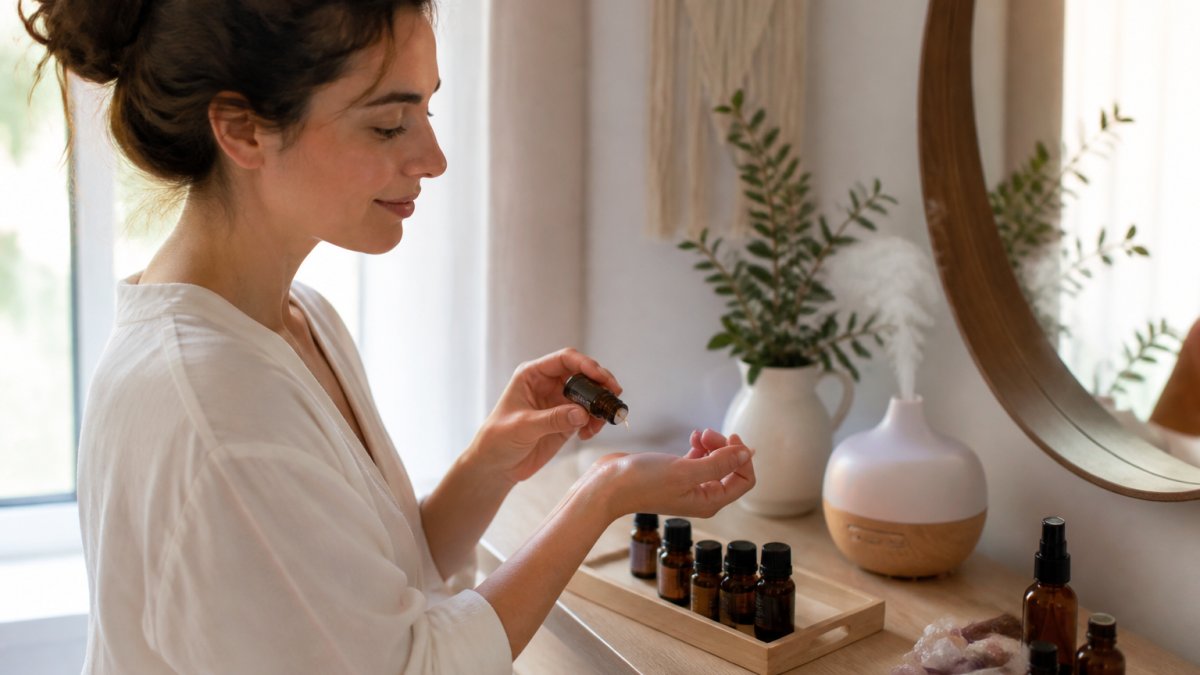
Dilution, Application, and Safety Basics
Dilution is measured in drops of essential oil per unit of carrier. For a single application to the wrists, 1 to 2 drops of essential oil blended into a teaspoon of carrier is often used.
- Choose a carrier. Jojoba, sweet almond, fractionated coconut, and grapeseed are common. A plain unscented lotion or cream base works too if you prefer a non-greasy finish.
- Dilute before skin use. Never apply a pure essential oil straight to skin. Mix into the carrier first, then apply.
- Patch test first. Place a small diluted drop on your inner forearm and wait 24 hours. If redness, itching, or burning appears, don't use that oil.
- Apply to pulse points. Wrists, temples, behind the ears, and the base of the throat are common spots. Avoid the eyes, inside the nose, and broken skin.
- Diffuse in short bursts. Run a diffuser for 15 to 30 minutes, then take a break. Long, continuous diffusion in a closed room can overwhelm the senses and irritate airways.
- Keep oils away from children's faces and pets. Store bottles out of reach, capped, in a cool, dark place.
A Morning, Workday, and Bedtime Routine
Here's a simple structure you can adapt:
- Morning (5 minutes). Diffuse one uplifting oil, bergamot, sweet orange, or grapefruit, while you get ready. If you prefer topical, dilute 1 drop of bergamot in a teaspoon of carrier and apply to your wrists before you leave.
- Workday reset (2 minutes). Keep a small roller or a tissue with a drop of frankincense or sandalwood within reach. When tension builds, cap the bottle, breathe slowly for 4 counts in and 6 counts out, three times. The slow exhale is doing as much work as the scent.
- Bedtime (20 minutes before sleep). Diffuse lavender, Roman chamomile, or clary sage in the bedroom with the door closed, then turn the diffuser off before you get in bed. If you'd rather apply topically, dilute 1 drop of lavender in a teaspoon of carrier and rub it into your wrists and the soles of your feet.
| Moment | Oil or Blend | How to Use |
|---|---|---|
| Winding down | Lavender, chamomile | Diffuse 20 minutes before bed |
| Overwhelmed | Frankincense, sandalwood | One drop on a tissue, breathe slowly |
| Low mood | Bergamot, citrus oils | Dilute and apply to wrists |
| Stress spike | Relaxation blend | Diffuse or apply diluted |
| Anxious moments | Calm cream | Rub a small amount on wrists |
Who Should Be Cautious
Aromatherapy isn't a fit for everyone, and the cautions matter more than the oil list:
- Pregnancy and breastfeeding. Many oils are traditionally avoided during pregnancy, and some, including clary sage and rosemary, are specifically flagged. Ask your obstetric provider before using any essential oil.
- Children. Dilution for children is much lower than for adults, and some oils, including eucalyptus and peppermint, are not recommended for young children. Check with a pediatrician first.
- Pets. Cats in particular have difficulty metabolizing many essential oils, and diffused oils can bother birds and small animals. Ventilate the room and keep pets out during diffusion.
- Medications and health conditions. If you take prescription medication, have asthma, or have a skin condition like eczema, talk to your clinician before adding oils to your routine.
- Allergies. If you're allergic to a plant, you're likely to react to its oil. Patch test every new oil, every time.
Choosing Quality Oils and Tracking What Works
Not all oils are equal, and the label is the only information most buyers get. Knowing what a label can and can't tell you is the difference between a useful bottle and an expensive one.
What a Label Tells You, and What It Doesn't
A well-labeled bottle usually names:
- The botanical name. Look for the Latin binomial, such as Lavandula angustifolia for true lavender. Common names alone are ambiguous, "lavender" can refer to several species with different scent profiles.
- The plant part. Lavender from the flower smells different from lavender from the leaf. Frankincense from Boswellia sacra is not the same as Boswellia carterii.
- The origin. Country of harvest affects scent and, in some cases, chemistry.
- The extraction method. Steam distillation and cold expression are the traditional methods. Solvent-extracted absolutes and CO2 extracts behave differently and are not interchangeable.
What a label generally does not tell you is purity. Terms like "therapeutic grade," "clinical grade," and "pure" are marketing language, not regulated standards.
Adulteration is common in the cheaper end of the market. A bottle may be diluted with a carrier oil, a synthetic aroma compound, or a lower-grade oil from a different species.
Store bottles capped, upright, in a cool, dark place. Citrus oils oxidize faster than woodsy oils and are best used within about a year of opening. Oxidation changes the scent and increases the chance of skin irritation.
What the Research Actually Supports
Aromatherapy research is real but preliminary. Most studies are small, short, and use different oils, doses, and outcome measures, which makes them hard to compare. The most consistent findings involve inhaled lavender for relaxation and sleep quality, and citrus oils for mood in short-term settings. That's a reasonable basis for trying a scent as a comfort tool.
Scent can shift how a moment feels. Treat positive results as a signal that the routine is pleasant and worth keeping.
A Simple Way to Track Whether It's Working
The "best" oil is the one that reliably shifts your mood, and only your own notes will tell you that. Keep it short, a note on your phone is enough:
- Date and time of day. Morning, mid-afternoon, and bedtime responses often differ.
- Oil or blend, and how you used it. Inhaled, diffused, or diluted topically.
- Mood before, rated 1 to 5. A simple number is easier to compare than a paragraph.
- Mood 15 to 30 minutes after, rated 1 to 5.
- Context. Poor sleep, a hard meeting, or a good day, context explains a lot of the variance.
After two weeks, look for patterns rather than single good days. If a scent consistently moves your number by a point or more, it can be a helpful tool. If a scent does nothing after several tries, consider trying a different one.
When to Seek Professional Mental Health Support
Essential oils are a comfort tool. If low mood, anxiety, or grief lasts for weeks, or gets in the way of daily life, talking to a doctor or licensed therapist can be helpful.
The Substance Abuse and Mental Health Services Administration helpline offers free, confidential support if you're not sure where to start. Oils can sit alongside professional care. They should never replace it.
Frequently Asked Questions
How do you use essential oils for emotional balance?
Start with inhalation: open the bottle and take a slow, deep breath, or add a few drops to a diffuser. For topical use, dilute essential oils in a carrier oil at 2-3% for adults and apply to wrists, behind the ears, or the soles of the feet. Wellaroma's Calm (Anxiety Relief) cream is already blended for wrist and ear application, so you can use a pinkie-tip amount as needed. Try one oil or blend at a time and note how you feel over several days.
Which essential oils can help with emotional release?
Oils often used for emotional release include frankincense, helichrysum, clary sage, and sandalwood. Frankincense and clary sage appear in blends like Wellaroma's Relaxation, which combines frankincense, geranium, lavender, mandarin orange, and marjoram. These oils are traditionally used during quiet reflection or journaling. Inhale slowly or diffuse for 15-30 minutes while you sit with your thoughts, and pair the scent with a calming routine rather than expecting it to resolve feelings on its own.
Can essential oils help with stress and anxiety?
Some research suggests certain oils, including lavender and bergamot, may support relaxation and reduce feelings of stress. Aromatherapy is best treated as a complementary practice, not a replacement for medical care. Wellaroma's Calm (Anxiety Relief) cream combines lavender, roman chamomile, clary sage, and helichrysum for moments when anxiety runs high. If anxiety interferes with daily life, talk to a licensed mental health professional about a full plan.
Is it safe to diffuse essential oils every day?
Daily diffusion is generally fine for healthy adults when you keep sessions short, around 15-30 minutes, and ventilate the room afterward. Use 3-5 drops in a diffuser and take breaks between sessions. If you have pets, asthma, or are pregnant or nursing, check with a physician first. Wellaroma notes that anyone pregnant, nursing, taking medication, or with a medical condition should consult their physician before using essential oil products.
Emotional balance is a daily practice, and scent can be one gentle part of it. If you want blends made for these exact moments, Wellaroma offers the Relaxation blend for tension, the Uplift blend for low days, and the Calm cream for anxious ones. Each is crafted for skin-friendly, family use. Add to cart and find the scent that steadies your day.

Leave a comment