


Essential Oil Safety for Sensitive Skin: 2026 Guide
Table of Contents
- Why Sensitive Skin Reacts Differently to Essential Oils
- Essential Oil Dilution Ratios for Sensitive Skin
- How to Patch Test Essential Oils Before Use
- Essential Oils to Avoid for Sensitive Skin
- Safe Essential Oils for Babies and Young Children
- Choosing Products for Sensitive Skin: What to Look For
- Storage and Oxidation: Keeping Essential Oils Safe Over Time
- Conclusion
- Frequently Asked Questions
Last Updated: September 25, 2026
Why Sensitive Skin Reacts Differently to Essential Oils
Essential oil safety for sensitive skin starts with one fact: plant oils are not automatically gentle. They are concentrated plant chemicals, and a reactive barrier absorbs them faster.
Signs of an Essential Oil Reaction
Reactions usually show up as irritant contact dermatitis or an allergic reaction, and the two behave differently.
Watch for these signs:
- Redness, warmth, or blotchy patches
- Itching or a burning feeling
- Swelling or puffiness
- Dry, cracked, or peeling skin
- Small blisters in severe cases
- Symptoms that appear hours later, not immediately
Essential Oil Dilution Ratios for Sensitive Skin
The right starting point for sensitive skin is a dilution ratio of 0.5% to 1%, roughly 3 to 6 drops of essential oil per ounce of carrier oil.
Here is how dilution works in practice:
| Skin Type | Dilution | Drops per 1 oz Carrier | Best For |
|---|---|---|---|
| Sensitive or reactive | 0.5% | 3 drops | First-time use, facial skin |
| Dry or mature | 1% | 6 drops | Body lotions, daily care |
| Normal adult | 2% | 12 drops | General body use |
| Children over 6 | 0.5% | 3 drops | Short-term, spot use |
Carrier Oil Selection by Skin Type
Carrier oil choice matters as much as the oil itself, and most guides skip this step.
Match the carrier to your skin:
- Dry skin: jojoba, avocado, or sweet almond oil
- Oily or acne-prone: grapeseed or fractionated coconut oil
- Reactive or eczema-prone: oat oil or squalane
- Combination skin: jojoba, which mimics natural sebum
How to Patch Test Essential Oils Before Use
A patch test is the only reliable way to check how your skin will respond before full use. It takes about 48 hours.
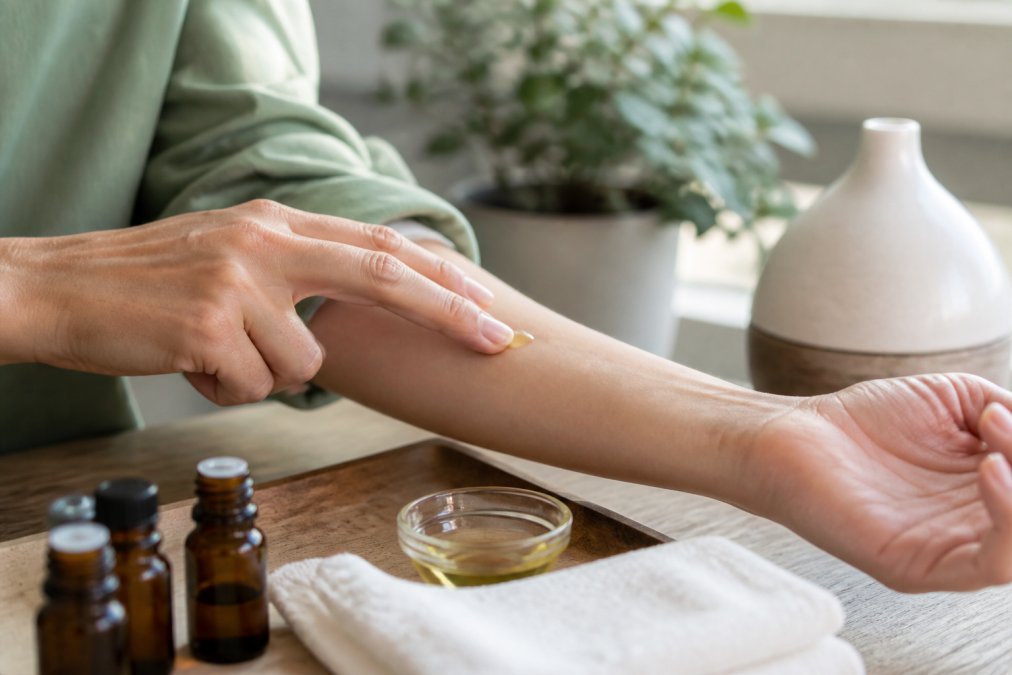
Follow this patch testing protocol:
- Mix your blend at your target dilution in a clean glass bowl.
- Wash and dry the inner forearm or behind the ear.
- Apply one small drop of the diluted blend to a small area.
- Cover it with a bandage and leave it for 24 hours.
- Remove the bandage and check for redness, itching, or swelling.
- Wait another 24 hours to catch delayed reactions.
- If the skin stays calm, the blend is likely safe for you.
Essential Oils to Avoid for Sensitive Skin
Some oils are far more likely to cause trouble. Know them by name, and by the compounds that make them risky, before you shop.
Oils to avoid or use with real caution:
- Cinnamon (bark and leaf): Contains cinnamaldehyde, a known contact allergen that can trigger burning and blistering even at low dilutions. The bark oil is more concentrated than the leaf.
- Clove bud: High in eugenol, which is both an irritant and a sensitizer. Dental products use it at tiny concentrations for a reason.
- Oregano and thyme: Rich in carvacrol and thymol, two phenols that are potent skin irritants. These are often sold as "hot oils" for a reason.
- Lemongrass and citronella: Contain citral, a common allergen that can cause stinging and redness on reactive skin.
- Peppermint: Menthol creates a cooling sensation that masks irritation; on sensitive skin it often triggers redness and a burning feeling instead.
- Eucalyptus: High in 1,8-cineole, which is risky for young children and can irritate reactive adult skin.
- Bergamot and other cold-pressed citrus: See the phototoxicity warning below.
- Tea tree: Popular for acne, but oxidized tea tree oil is one of the most common causes of allergic contact dermatitis. Only use fresh, properly stored oil, and patch test first.
- Ylang-ylang: Heavy, sweet, and a frequent sensitizer, especially in leave-on products.
Phototoxic and Acidic Oils
Phototoxicity is a reaction where an oil makes skin far more sensitive to sunlight. Citrus oils such as bergamot, lime, lemon, and grapefruit are the classic offenders because they contain furanocoumarins, which react with UV light.
Bergamot is available in two forms: bergapten-free (also called bergaptene-free or FCF) and standard cold-pressed. The FCF version has the phototoxic compounds removed, but it still carries irritation risk on sensitive skin. Do not assume "bergapten-free" means "safe for reactive skin." ::: Prioritizing gentle botanical alternatives remains the most reliable strategy when building a balanced sensitive skin routine.
Why Oxidation Makes 'Safe' Oils Unsafe
Here is a gap most guides miss: a normally gentle oil can become a problem after it oxidizes. Air, heat, and light break down the plant compounds, creating molecules like peroxides and aldehydes that are far more allergenic than the original oil. That is why the same bottle of lavender that worked last year may suddenly sting, it is the oil, not your skin.
Signs an oil has oxidized:
- The scent is sharp, sour, or "off" instead of true to the plant
- The color has darkened or become cloudy
- The texture feels thicker or stickier than when you opened it
- It has been open for more than 12 months (citrus oils: 6 months)
Safe Essential Oils for Babies and Young Children
Safe essential oils for babies are limited, and the rules are stricter than for adults. For infants under 6 months, the safest choice is none at all.
- Roman Chamomile: calming and mild, good for bedtime routines
- Lavender: widely used, but still dilute to 0.5% or less
- Geranium: floral and gentle on young skin
- Palmarosa: soft, rosy, and well tolerated in blends
Choosing Products for Sensitive Skin: What to Look For
Reading a label protects you better than any marketing claim, but most guides stop at "avoid fragrance", not enough when evaluating a product that contains essential oils.

Look for these on the label:
- A clear dilution listed, or a product already blended for skin
- Short ingredient lists with recognizable botanical extracts
- No added synthetic fragrance or dyes
- "Hypoallergenic" or "for sensitive skin" claims backed by ingredient detail
- A full list of oils used, not just "fragrance" or "essential oil blend"
The Interaction Most Guides Ignore
Here is the gap: most articles list oils to avoid, but almost none explain how essential oils interact with the skincare actives already in your routine. If you use any of the following, your skin is more permeable and essential oils hit harder:
- Retinoids (retinol, tretinoin): These accelerate cell turnover and thin the outer skin layer. Adding essential oils on top increases absorption and irritation risk. Use them at different times of day, retinoid at night, any oil blend in the morning, or vice versa.
- AHAs and BHAs (glycolic, lactic, salicylic acid): These exfoliate the barrier itself. Layering an essential oil blend on freshly exfoliated skin is one of the fastest routes to a reaction. Wait at least 30 minutes, and dilute further than you normally would.
- Vitamin C (L-ascorbic acid): Already acidic and potentially irritating. Combining it with acidic essential oils like lemongrass compounds the sting.
- Niacinamide: Generally well-tolerated, but can cause flushing in some people. Adding essential oils makes it harder to tell which product caused a reaction.
- Hyaluronic acid: Not an irritant itself, but it increases skin hydration and can enhance penetration of whatever you apply next, including essential oils.
Carrier Oil Selection by Skin Type
Carrier oil choice matters as much as the essential oil itself, and most guides skip it. The wrong carrier can clog pores, feel heavy, or fail to support a reactive barrier.
Match the carrier to your skin:
- Dry skin: jojoba, avocado, or sweet almond oil, rich and occlusive
- Oily or acne-prone: grapeseed or fractionated coconut oil, lightweight, low comedogenic rating
- Reactive or eczema-prone: oat oil or squalane, soothing, close to skin's natural lipids
- Combination skin: jojoba, which mimics natural sebum and balances without heaviness
- Mature skin: rosehip or argan oil, higher in antioxidants, supports barrier repair
Storage and Oxidation: Keeping Essential Oils Safe Over Time
Oils change as they age. Oxidation happens when air, heat, and light break down the plant compounds, and an oxidized oil can irritate skin that once tolerated it fine, which is why the same bottle that worked last year may suddenly sting.
Store your oils the right way:
- Keep them in dark glass bottles, tightly capped
- Store in a cool, dark place away from sunlight
- Avoid the bathroom, where heat and steam speed up breakdown
- Check the scent: a sharp or sour smell means it has turned
- Replace citrus oils sooner than heavier oils like chamomile
Conclusion
Sensitive skin does not mean giving up aromatherapy, it means slowing down, diluting properly, and testing before you commit.
Frequently Asked Questions
How do you perform a patch test for essential oils?
Dilute one drop of essential oil in a teaspoon of carrier oil. Apply a small amount to the inner forearm or behind the ear. Cover with a bandage and wait 24 to 48 hours. Check for redness, itching, or swelling. If no reaction appears, the oil is likely safe for that dilution. Always patch test each new oil separately, and never test on broken or irritated skin.
Which essential oils are good for sensitive skin?
Oils like Roman chamomile, geranium, and palmarosa are often tolerated by sensitive skin when properly diluted. Roman chamomile is known for its gentle, calming properties. Geranium and palmarosa blend well with other oils and are frequently used in skincare for reactive skin. Always dilute to 0.5 to 1 percent and patch test before applying to larger areas.
What are the signs of an essential oil reaction on sensitive skin?
Signs include redness, itching, swelling, blistering, or a burning sensation. These can appear immediately or develop over hours. If you notice any of these, wash the area with mild soap and water, apply a cool compress, and stop using the oil. Seek medical attention if symptoms are severe or spread. Sensitization can build over time, so even a previously safe oil may cause a reaction later.
Can essential oils cause long-term skin sensitization?
Yes. Repeated exposure to undiluted or high-concentration essential oils can lead to sensitization, where the immune system becomes increasingly reactive. This can cause allergic contact dermatitis. To prevent it, always follow safe dilution ratios, rotate the oils you use, and avoid known sensitizers like cinnamon, clove, and citrus oils if you have sensitive skin.

Leave a comment